Overview
At a glance
Is this game right for my group?
ABG editorial scores on a 1–5 scale.
Harder to teach
High replayability
Highly interactive
Scales well
Deep strategy
How it plays
How does it play?
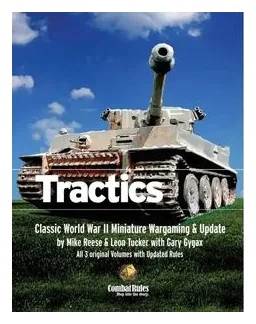
Tracticts was created in 1971 by Mike Reese and Leon Tucker with contributions by Gary Gygax. Its theme was World War 2 Combat and it was published by Guidon Games in 1971 and republished by TSR, Inc.
Core mechanisms
Key systems that shape the decisions players make.
Read the full game description
Tracticts was created in 1971 by Mike Reese and Leon Tucker with contributions by Gary Gygax. Its theme was World War 2 Combat and it was published by Guidon Games in 1971 and republished by TSR, Inc. in 1975. Its combat style involved 1:285 scale micro armour miniatures. When it was first created it used the 1/87 scale miniatures that were common but this later changed. The game came as a boxed set containing three booklets illustrated by Don Lowry. Tractics was innovative when it was published due to the fact that it was the first game that was published using a 20-sided die. In 1968 Reese and Tucker, two members of the LGTSA, began play-testing rules for tank combat that would eventually form the core of Tractics. Gygax contributed some rules on infantry, covered in the second booklet, and the third booklet would cover additional topics such as airstrikes and the MODERN period (which at the time included rumors of the XM-1 tank). The players must first acquire the miniatures and build the terrain. Reese and Tucker were interested in an accurate simulation, and as a result the game provides data describing the rate of movement, thickness of armor, and rate of fire for the makes of tank in service from 1940 to 1970. The tanks in Tractics have a 30% chance to hit a target which in essence means rolling at least a 15 on the 20 sided die. The modifiers of battle apply depending upon several factors such as concealment. The game is consequently slower to conduct than a board wargame such as Tactics II. For miniature wargamers who felt that the amount of detail was excessive, Reese and Tucker recommended their earlier Fast Rules (1970) although that set covered WWII only. Tractics requires the use of a judge. Since players are unaware of their enemies locations, the pieces are placed on the map only when they are detected or they march to an open view.