Overview
At a glance
Is this game right for my group?
ABG editorial scores on a 1–5 scale.
Harder to teach
High replayability
Highly interactive
Scales well
Deep strategy
How it plays
How does it play?
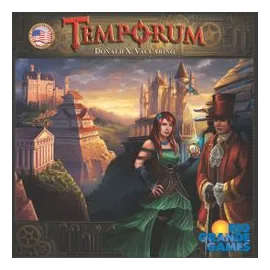
Game description from the publisher: In some of the best versions of reality, the Egyptians discover America, the industrial revolution happens early, and eventually robots take over.
Core mechanisms
Key systems that shape the decisions players make.
Area Majority
Compete to have the strongest presence in areas that award control or points.
Modular Board
Build the play area from interchangeable sections that vary between games.
Hand Management
Time and sequence a limited hand of cards to preserve future options.
Point-to-Point Movement
Move along explicit connections between named locations or nodes.
Read the full game description
Game description from the publisher: In some of the best versions of reality, the Egyptians discover America, the industrial revolution happens early, and eventually robots take over. In others, the Renaissance produces a plutocracy, which leads to a utopia — or perhaps to anarchy; it's all in the subtle details. As a time-traveler, you've seen it all, and it all has its place. What's important is who's in control in the long run when time travel is invented. With other time-travelers mucking with things for their own reasons, your course is clear: you will tamper with history as much as is needed, stepping on however many butterflies it takes, to get a perfect world under your own benign rule. In Temporum, the board shows the possible paths history can take and the actual path it currently takes. On your turn, you can change history, travel through time, and visit a point in history. You draw cards, play some of them for money and abilities, and score some of them to advance your power through history. Having more power in a time period gives you abilities, but your goal is to have all of your power in the last time period, the time from which you come.