Overview
At a glance
Is this game right for my group?
ABG editorial scores on a 1–5 scale.
Harder to teach
High replayability
Highly interactive
Scales well
Deep strategy
How it plays
How does it play?
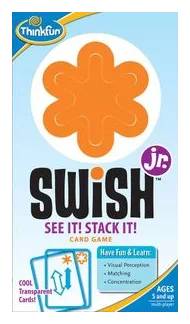
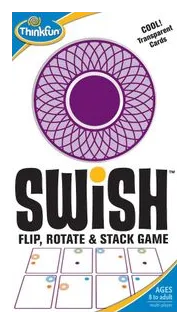
Swish is a pattern recognition card game reminiscent of Set that challenges a player to make matches – dubbed "Swishes" – before opponents. Swish includes 60 transparent cards; each card has some combination of balls and hoops on it, with these items coming in four colors.
Core mechanisms
Key systems that shape the decisions players make.
Pattern Building
Place elements to create arrangements that satisfy scoring or action patterns.
Pattern Recognition
Identify recurring visual, spatial, or logical arrangements.
Set Collection
Gather related items that become more valuable when scored together.
Speed Matching
Quickly identify and claim matching symbols or properties before opponents.
Read the full game description
Swish is a pattern recognition card game reminiscent of Set that challenges a player to make matches – dubbed "Swishes" – before opponents. Swish includes 60 transparent cards; each card has some combination of balls and hoops on it, with these items coming in four colors. To set up the game, lay out 16 cards on the table. Players simultaneously try to create "Swishes" by spotting two or more cards that can be laid on top of one another in some manner so that every ball fits in a hoop of the same color. Create a Swish, and you claim the cards used, with new cards then being laid out. Whoever claims the most cards wins the game. The game includes varied levels of play so that the spatially clueless can compete against Tetris-heads.