Overview
At a glance
Is this game right for my group?
ABG editorial scores on a 1–5 scale.
Harder to teach
High replayability
Highly interactive
Scales well
Deep strategy
How it plays
How does it play?
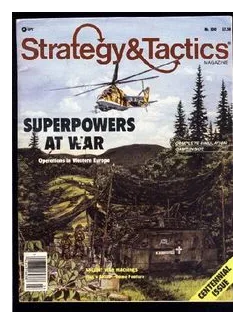
The SUPERPOWERS AT WAR game presents two hypothetical regimental level campaign scenarios set in West Germany following the hypothetical outbreak of a conflict between NATO and Warsaw Pact countries. The Drive on Munich Scenario is set in an early phase of the conflict.
Core mechanisms
Key systems that shape the decisions players make.
Read the full game description
The SUPERPOWERS AT WAR game presents two hypothetical regimental level campaign scenarios set in West Germany following the hypothetical outbreak of a conflict between NATO and Warsaw Pact countries. The Drive on Munich Scenario is set in an early phase of the conflict. The Warsaw Pact player must capture Munich and drive back the NATO forces in southern West Germany. A variety of NATO forces have gathered to stop the onrushing Soviet and Czech forces. The Across the Rhine Scenario begins at a later stage in the conflict, with the assumption that the Warsaw Pact has broken through the “forward defense” lines of NATO. The Warsaw Pact player tries to move his substantial forces over the Rhine River and into the open country beyond, while retreating NATO units stream onto the map, trying desperately to evade the closing Soviet pincers and to fight a successful delaying action. The game is played in a series of double impulse game turns, during which the initiative (first move and attack) may pass from player to player. Movement and attacks are halved in the second impulse. The ground scale is 4 kilometers per hex, with each game turn representing about 24 hours. The Game Map: The Drive on Munich map covers the area from the Austrian border to Munich. The Across the Rhine map covers the area from the Ruhr to Belgium. A hexagonal grid has been superimposed on each map to regulate movement; each hex has an identity number. GAME PARTS: • One 22 " * 32.5 " game map • One counter sheet of 200 cardboard playing pieces • One 16-page rule booklet • One six-sided die (not included in magazine version) • One game box (not included in magazine version) (from the rulebook)