Overview
At a glance
Is this game right for my group?
ABG editorial scores on a 1–5 scale.
Harder to teach
High replayability
Highly interactive
Scales well
Deep strategy
How it plays
How does it play?
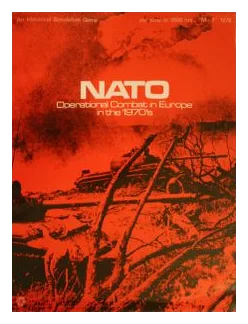
"NATO: Operational Combat in Europe in the 1970's" is a simulation on a brigade/division level of a possible attempt by the Warsaw Pact forces to "liberate" Western Europe from the NATO alliance sometime in the 1970's.
Core mechanisms
Key systems that shape the decisions players make.
Read the full game description
"NATO: Operational Combat in Europe in the 1970's" is a simulation on a brigade/division level of a possible attempt by the Warsaw Pact forces to "liberate" Western Europe from the NATO alliance sometime in the 1970's. It postulates that this War in West Germany could occur without a massive strategic nuclear holocaust. Essentially, the game progresses from "M," the day' the Warsaw Feet decides to launch an offensive, to day "M + 50," when a decision of some type (even a stalemated war) is assumed to have been reached. The game may be played starting with "M + 1," with the forces as they actually are in peacetime, or at "M + 31," after both sides have reached planned strength. The increment of forces, as NATO transfers its scattered strength and Warsaw Pact sends forth additional member and Russian garrison divisions, is fully charted between the 'two game-versions. NATO depicts the essential elements of modern warfare (even Future warfare) with unusual elements such as Air-transportable units, Airmobile units and the newly proposed US Army Tricap (triple capability) divisions. Two basic scenarios (4 if nukes are used in two of them) and three variants (Warsaw Pact Unreliability, NATO Neutrality and Chinese Intervention). The map portrays Europe from East Germany to France and from Denmark to Switzerland. Game Scale: Game Turn: 2 days Hex: 10 miles / 16 kilometers Units: Brigade to Division Game Inventory: One 22 x 34" four color map One single-side printed countersheet (400 1/2" counters) One 10-page rulebook One player aid fold-out sheet Solitaire Playability: High Complexity Level: Medium Players: 2 or more Playing Time: 4-15 hours