Overview
At a glance
Is this game right for my group?
ABG editorial scores on a 1–5 scale.
Harder to teach
High replayability
Highly interactive
Scales well
Deep strategy
How it plays
How does it play?
Once more, conflict rages across the world of Aerim. You are one of the Eternals, a group of immortals forever waging war from the shadows.
Core mechanisms
Key systems that shape the decisions players make.
Pattern Building
Place elements to create arrangements that satisfy scoring or action patterns.
Hand Management
Time and sequence a limited hand of cards to preserve future options.
Simultaneous Action Selection
Choose actions secretly or concurrently before revealing them together.
Advantage Token
A transferable advantage changes ties, priority, or the strength of an action.
Read the full game description
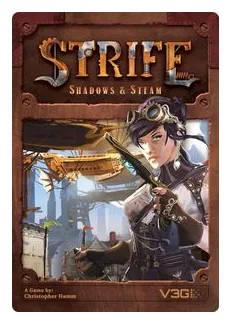
Once more, conflict rages across the world of Aerim. You are one of the Eternals, a group of immortals forever waging war from the shadows. Call forth your champions to battle against those of your timeless foes. Harness the legacy of each champion's deeds as they echo across time to empower the next. For the Champions of Aerim, this cycle continues, as it always has and always will. For the Eternals, there is only...strife. Strife, a two-player strategy card game that plays in around an hour, is a game where you always know your opponent's options. Aside from mastering the unique combo-creating gameplay of your champions, figuring out how to outmaneuver your opponent is where the true challenge lies. Each player has the same hand of ten champions and will simultaneously play them as they fight over key locations throughout Aerim worth varying victory points. Each champion has a battle ability that's triggered during battles and a legacy ability that can be used only while on top of the legacy pile. This creates an intricate latticework of strategy for the players as each champion must be considered for not only what he can do in the current battle, but for which ability he will add to the next. Further impacting the critical decisions within the game is the Fatestone tie-breaking system. The Fatestone starts at a value of one, and whoever holds the Fatestone die loses all ties; that player may instead pass the stone to his opponent to claim a victory in that tie, but doing so raises the value of the Fatestone by one each time it is passed. At the end of the game, the player holding the Fatestone adds its final value to his victory point tally. Whichever player has the most victory points at the end of the game wins!