Overview
At a glance
Is this game right for my group?
ABG editorial scores on a 1–5 scale.
Harder to teach
High replayability
Highly interactive
Scales well
Deep strategy
How it plays
How does it play?
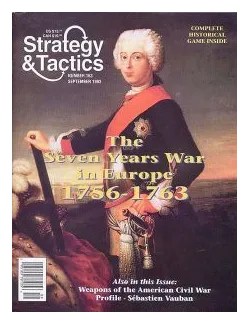
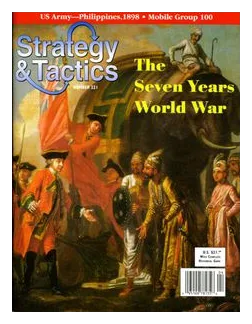
Strategy & Tactics magazine #221. Seven Years World War (7YWW) is a wargame simulating the global conflict of 1756-63.
Core mechanisms
Key systems that shape the decisions players make.
Dice Rolling
Roll dice to introduce uncertainty into actions, production, movement, or resolution.
Variable Player Powers
Each player has different abilities, restrictions, or strategic advantages.
Hexagon Grid
Use a hexagonal map where each space connects evenly in six directions.
Square Grid
Use an orthogonal grid where position and adjacent spaces shape movement or placement.
Read the full game description
Strategy & Tactics magazine #221. Seven Years World War (7YWW) is a wargame simulating the global conflict of 1756-63. That war was fought primarily between two coalitions of European powers, but it also involved fighting in the Americas, India and the East Indies, as well as on the high seas. It was also a time of expansion for the Manchu Empire, which could have put China on a collision course with the Europeans. Historically, the Seven Years War resulted in the domination of central Europe by Prussia and of North America and India by Great Britain. Seven Years World War can be played by two, three, or four, each representing a different coalition of powers. Each player has a variety of military, diplomatic and economic instruments with which he can attempt to dominate the world. The Major Powers includes: Austrian Empire, France, Great Britain, Maratha Confederation (India), Manchu Empire (China), Ottoman Empire, Prussia, Russian Empire, Spanish Empire, and United Provinces (Netherlands). The game map shows the world as it was during the mid-18th century. A square grid has been superimposed on the map to regularize the position and movement of the playing pieces. Players should note the actual geographic boundaries of the various empires and powers are slightly distorted to clarify their position on the map. The game is won by gaining control of strategic objectives that can then be translated into success at the peace table.