Overview
At a glance
Is this game right for my group?
ABG editorial scores on a 1–5 scale.
Harder to teach
High replayability
Highly interactive
Scales well
Deep strategy
How it plays
How does it play?
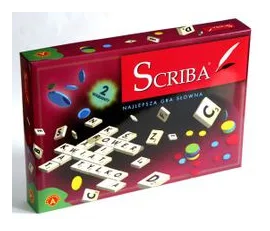
Scriba is yet another Scrabble clone. Quite popular on Polish market due to much lower price.
Core mechanisms
Key systems that shape the decisions players make.
Read the full game description
Scriba is yet another Scrabble clone. Quite popular on Polish market due to much lower price. Scriba is an extended version of Scriba Travel, because it provides two variants of gameplay. The first variant is exactly the same, but the second is quite insane. The first variant is similar to Scrabble (but there are some differences). Players use their 6/7/8 (this is up to the players) drawn letter-tiles to form words on the gameboard. Each word laid out earns points based on the commonality of the letters used, with certain board spaces giving bonuses. But a word can only be played if it uses at least one already-played tile or adds to an already-played word. The differences between Scriba (1st variant) and Scrabble are: - If you play all but one letter from your rack you get 20 points bonus. - You can stack the letters on top of the already played (like in Upwords), but only two levels of letters are allowed - There are negative bonuses on the board. - The player that ends the game receive 50 points bonus (because he played all his letters, we don't mind if he had one or two). - If a player passes, he receives minus 5 points. - The are tiles with no letter but with a black spot. This can be placed anywhere adjacent to already played tiles and is usually used to prevent from extending a particular word. - The are tiles with a curved arrow (wich looks like 'enter key') which allows to play a word half vertically and half horizontally. The second variant uses every rule from first variant with some additional rules: - The players use chips in four colors to place all the bonuses on the board wherever they want. - Whenever a player uses the bonus, he takes the chip from the board and places it in front of him. Every chip is worth 1 point during the final scoring. - The start player does not have to place his first word in the middle of the board. - After every move the player roll a d6 and draws that number of letter-tiles. - There are 12 big yellow chips which at the start of the game are distributed to the players in equal shares. Every chip is worth 10 points at the end of the game. Whenever a player plays exactly four letter-tiles from is rack, he can take one big chip from a chosen opponent.