Overview
At a glance
Is this game right for my group?
ABG editorial scores on a 1–5 scale.
Harder to teach
High replayability
Low interaction
Scales well
Deep strategy
How it plays
How does it play?
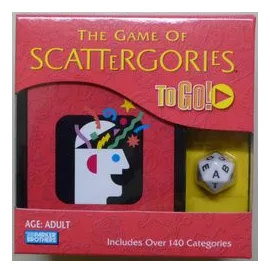
"The Game of Scattergories," published in 1988 by Milton Bradley, is a great game for any group to play. In the game each player fills out a category list 'with answers that begin with the same letter.' If no other player matches your answers, you score points.
Core mechanisms
Key systems that shape the decisions players make.
Read the full game description
"The Game of Scattergories," published in 1988 by Milton Bradley, is a great game for any group to play. In the game each player fills out a category list 'with answers that begin with the same letter.' If no other player matches your answers, you score points. The game is played in rounds. After 3 rounds a winner is declared, and a new game can be begun. Scattergories is a commercial version of an old parlour game known as Categories or Guggenheim. Similar to: Facts in Five