Overview
At a glance
Is this game right for my group?
ABG editorial scores on a 1–5 scale.
Harder to teach
High replayability
Highly interactive
Scales well
Deep strategy
How it plays
How does it play?
Rome is in a state of emergency, the Senate and the Guard are embroiled in fierce arguments, the people are divided.
Core mechanisms
Key systems that shape the decisions players make.
Action Points
Spend a limited allowance of points across several possible actions each turn.
Open Drafting
Select cards or items from a shared face-up display.
Dice Rolling
Roll dice to introduce uncertainty into actions, production, movement, or resolution.
Hand Management
Time and sequence a limited hand of cards to preserve future options.
Tags
Attach changing labels or properties that modify how components behave.
Take That
Direct negative effects at selected opponents.
Read the full game description
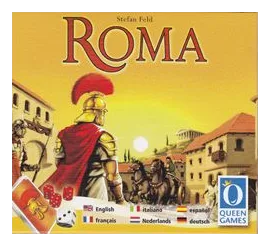
Rome is in a state of emergency, the Senate and the Guard are embroiled in fierce arguments, the people are divided. Many roads lead to Rome, whether you decide to use powerful cards such as the Tower and the Praetorian Guard to protect the power and victory points you have, or instead prefer to use the Consul and the Tribune to skilfully pull the strings behind the scenes. Whoever succeeds in using their connections and manages to play their cards cleverly will at the end deserve their victor's laurels. Roma features unique card and dice play. Players place cards at "dice stations" numbered 1-6. The player uses dice rolled each turn to activate dice stations to use the card that has been placed at a station. Card effects guide your tactical actions in the game through manipulating cards in play, providing money or granting victory points. In each game of Roma, there are a fixed amount of victory points in play, once all victory points have been collected, the player who has the most victory points wins the game. Can be combined with its sequel game, Arena: Roma II, with varying play options. Integrates with: Arena: Roma II