Overview
At a glance
Is this game right for my group?
ABG editorial scores on a 1–5 scale.
Harder to teach
High replayability
Highly interactive
Scales well
Deep strategy
How it plays
How does it play?
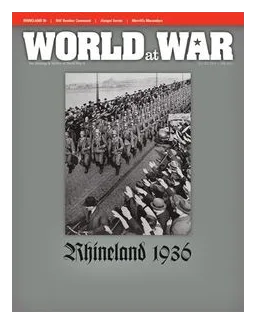
The Rhineland Crisis War, 1936-37, designed by Joseph Miranda,is a strategic-level simulation of intermediate complexity that covers an alternative World War II in Europe, one that began in 1936.
Core mechanisms
Key systems that shape the decisions players make.
Read the full game description
The Rhineland Crisis War, 1936-37, designed by Joseph Miranda,is a strategic-level simulation of intermediate complexity that covers an alternative World War II in Europe, one that began in 1936. The assumption is, when Hitler ordered his army to march into the Rhineland, the Allied powers, instead of appeasing him, ordered their armed forces to resist. The ensuing chain of events leads to the war expanding throughout Europe. A war fought at that time would’ve found all European militaries woefully unprepared. Central to the play of the game are its “crisis chits.” They represent various diplomatic and military events that could bring other powers into the war. Players pick crisis chits depending on the number of crisis hexes (printed on the map) they control. The more such hexes they control, the greater the chances they have of gaining more allies. At the same time, grabbing too much territory can lead to political collapse at home, as domestic foes work to undermine your power before the conflict explodes into a wider war. Rhineland Crisis War is a two-player game. One player commands the Axis, controlling Germany and the countries that choose to align with Berlin. The other is the Allied player, who controls the anti-German forces. Each hex on the map represents 62 miles (100 km) from side to opposite side. Each full game turn represents one month. Units of maneuver are corps and armies. Special rules cover: crises, political collapse, reinforcements, replacements, terror bombing, railroads, fog of war, airpower, naval and amphibious operations, weather, neutrals, the Soviet Union, armistice and surrender, the Spanish Civil War, expeditionary forces, airborne units, air transport, fifth columns, alpine units, and anti-aircraft units. The turn sequence is as follows. I. Axis Player Turn A. Axis Mobilization Phase B. Axis Terror Bombing Phase C. Axis Movement Phase D. Axis Combat Phase E. Axis Rally Phase F. Axis Crisis Phase II. Allied Player Turn A. Allied Mobilization Phase B. Allied Terror Bombing Phase C. Allied Movement Phase D. Allied Combat Phase E. Allied Rally Phase. F. Allied Crisis Phase III. End of Turn Phase