Overview
At a glance
Is this game right for my group?
ABG editorial scores on a 1–5 scale.
Harder to teach
High replayability
Highly interactive
Scales well
Deep strategy
How it plays
How does it play?
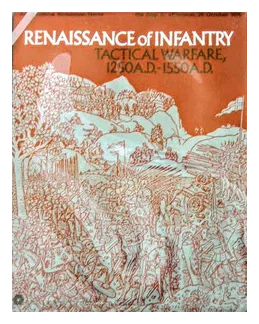
Renaissance of Infantry Tactical Warfare 1250A.D. - 1550A.D.
Core mechanisms
Key systems that shape the decisions players make.
Grid Movement
Move pieces between adjacent spaces on a regular grid.
Dice Rolling
Roll dice to introduce uncertainty into actions, production, movement, or resolution.
Movement Points
Spend a movement allowance across spaces with different costs.
Hexagon Grid
Use a hexagonal map where each space connects evenly in six directions.
Line of Sight
Visibility between pieces determines valid targets, movement, or effects.
Read the full game description
Renaissance of Infantry Tactical Warfare 1250A.D. - 1550A.D. An Historical Simulation Game, the time is: afternoon, 25 October 1415. RENAISSANCE OF INFANTRY (originally Strategy & Tactics magazine #22) (Tactical Warfare, 1250AD to 1550AD) 20 different scenarios Melee and Fire combat Bonus PanzerBlitz mini-game Re-fight the battles of Bannockburn, Crecy, Bicocca, Agincourt and many more. Renaissance of Infantry marks the beginning of a whole new line of games. The units in the game are composed of no more than 500 men. Each hex represents 100 meters and each turn represents approximately 20 minutes. During this historical period, the mounted "man-at-arms" (or "knight in shining armor") fell prey to the better organized and disciplined infantry. After eight hundred years of dominance, the armored horseman again became a second class warrior. The game shows how, and why, infantry lost their traditional dominance -- and how they regained it. There are 20 different games. Each is a historical battle with its own order of battle, set-up and victory conditions. Some of the units included in the game are: militia pikemen, crossbowmen, pikemen, arquebusiers, swordsmen, longbowmen and heavy cavalry.