Overview
At a glance
Is this game right for my group?
ABG editorial scores on a 1–5 scale.
Harder to teach
High replayability
Highly interactive
Scales well
Deep strategy
How it plays
How does it play?
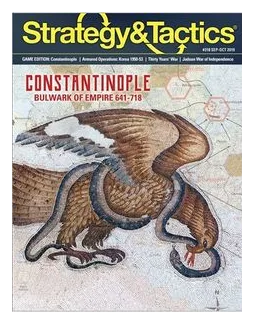
Constantinople is a solitaire wargame system covering the Byzantine (or Later Roman) Empire in the late 7th and early 8th centuries, the era of the two Barbarian sieges of the great City of Constantinople (AD 672, 717). The player controls Byzantine and allied forces.
Core mechanisms
Key systems that shape the decisions players make.
Grid Movement
Move pieces between adjacent spaces on a regular grid.
Dice Rolling
Roll dice to introduce uncertainty into actions, production, movement, or resolution.
Movement Points
Spend a movement allowance across spaces with different costs.
Scenario Campaign
Play linked or standalone scenarios with their own setup, objectives, and consequences.
Hexagon Grid
Use a hexagonal map where each space connects evenly in six directions.
Read the full game description
Constantinople is a solitaire wargame system covering the Byzantine (or Later Roman) Empire in the late 7th and early 8th centuries, the era of the two Barbarian sieges of the great City of Constantinople (AD 672, 717). The player controls Byzantine and allied forces. The game system controls various barbarian forces: Caliphates of Egypt, Syria and Mosul, Khazar Khanate, Bulgar Kingdom, Slavic Tribes and Lombard Kingdom. The objective of the player is to defeat Barbarians while expanding Byzantine power. Each turn represents a campaign season, from three months to a year. Ground units represent 10-30,000 soldiers or warriors. Each hex is about 55 miles across. Fortresses represent single great fortresses. Towns represent larger settled areas. Components: One 22" x 34" map & 176 counters Magazine: Strategy & Tactics #318