Overview
At a glance
Is this game right for my group?
ABG editorial scores on a 1–5 scale.
Harder to teach
High replayability
Highly interactive
Scales well
Deep strategy
How it plays
How does it play?
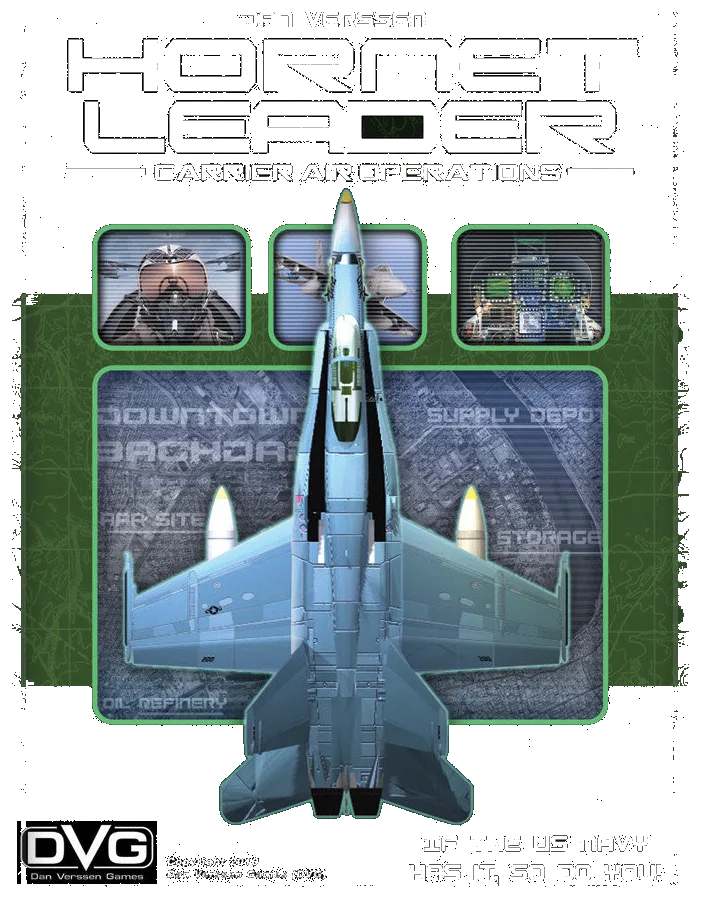
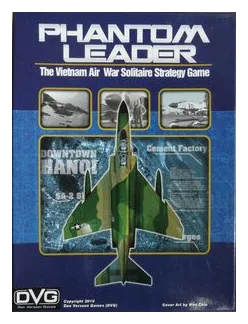
Phantom Leader - Solitaire Description: Phantom Leader places you in command of a US Air Force or US Navy Tactical Fighter squadron in Vietnam between 1964 and 1972.
Core mechanisms
Key systems that shape the decisions players make.
Open Drafting
Select cards or items from a shared face-up display.
Campaign Card Play
Play cards to command conflicts and carry consequences through a campaign.
Dice Rolling
Roll dice to introduce uncertainty into actions, production, movement, or resolution.
Simulation
Model a real or imagined system through detailed cause-and-effect rules.
Read the full game description
Phantom Leader - Solitaire Description: Phantom Leader places you in command of a US Air Force or US Navy Tactical Fighter squadron in Vietnam between 1964 and 1972. You must not only destroy the targets but you must also balance the delicate political repercussions of your attacks. If you strike too hard, your air offensive might be put on hold, strike too light, and you’ll be blamed for losing the war. Welcome to the Vietnam Air War! Each of the campaigns can be played with either an Air Force or Navy squadron. The targets assigned to each service are different and change the complexion of the campaigns. Each campaign can be played with three different durations of: Skirmish, Conflict, or War. Each mission takes roughly 30 minutes to set-up, plan, and resolve. Each of your pilots has their own skills. Selecting the right pilots and weapons for a mission is vital to its success. As you fly missions, your pilots will gain experience and fatigue. With experience, their skills improve, but as their fatigue increases, their skills decrease and they might not be able to fly for several missions. For those of you familiar with our modern era Hornet Leader series of games, you might be wondering what’s different about Phantom Leader… The freedom of being able to select the best mission based on military objectives is something that is commonplace for today’s military. Back in Vietnam, the military was responsible for carrying out their orders, while at the same time being extremely limited in the weapons and tactics they were allowed to use to complete those orders. In many cases, the specific weapons, approach paths, and bombing altitudes were generated target-by-target at the White House. The mission specifics were then sent down the chain of command to the individual pilots flying the mission. As you can imagine, this was not the best way to run an air campaign. Every target has a Political value. If you destroy it, you move the Political counter to the right a number of spaces equal to its value. As the counter gets moved to the right, your future target choices are reduced to those that are less politically sensitive. Which target you choose not to attack is also important. You get to move the Political counter to the left a number of spaces equal its Political value. [this last sentence is not in fact true for the game, though it appears in the game blurb; confirmed by the author] This means that while you might like to flatten a big enemy target and rack up the victory points, it might be better for you to choose a pointless target and move the Political counter in your favor instead. Another difference is in combat power. For the last couple decades, the US Air Force and Navy have enjoyed air superiority due to training and technology. Such was not the case in the skies over Vietnam. The enemy had different, but just as capable, equipment. They also had the training and will to use it to its utmost. They soon became aware of the limitations placed on the US forces by the politicians, and used those limitations to their advantage. For example, at times, US pilots were not permitted to fire on enemy aircraft until they were visually identified. This negated any range advantage conveyed by the radar-homing AIM-7 Sparrow missiles. It was also a common limitation that enemy aircraft could only be attacked in the air. US pilots were not allowed to attack enemy airbases. US aircraft were also limited to flying predictable flight paths, at set times. This made setting up ambushes much easier for the enemy. So, while you might be a Hornet Leader ace, Vietnam is a whole different ballgame! Components: 110 Full color Cards 12 F-4 Phantom IIs (USAF) 8 F-105 Thunderchiefs (USAF) 2 F-105G Wild Weasels (USAF) 4 F-100 Super Sabers (USAF) 2 F-104A Starfighters (USAF) 1 EB-66 Destroyer (USAF) 8 F-4 Phantom IIs (USN) 6 A-4 Skyhawks (USN) 5 A-7 Corsair II (USN) 5 A-6 Intruders (USN) 4 F-8 Crusaders (USN) 1 EA-6A Electric Intruder (USN) 34 Targets 18 Special Events Full Color, 20-page Rulebook Full Color Double-sided Counter Sheet (176 x 5/8" counters) 6 Full Color Campaign Sheets War in the South (1965) USAF & USN Rolling Thunder (1967) USAF & USN Linebacker (1972) USAF & USN 3 Full Color Player Aid Cards Tactical Display Card Diplay Sheet Help Sheet 1 Ten-sided die 1 Player Log master (to be photocopied prior to play) Other Leader series games by Dan Verssen Re-implemented by: Phantom Leader: Deluxe Edition