Overview
At a glance
Is this game right for my group?
ABG editorial scores on a 1–5 scale.
Harder to teach
High replayability
Highly interactive
Scales well
Deep strategy
How it plays
How does it play?
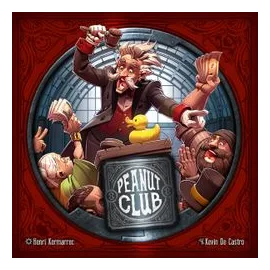
Welcome to the Peanut Club! As a famous collector you're invited to a tremendous auction sale wich take place at the cross of disparate universes.
Core mechanisms
Key systems that shape the decisions players make.
Read the full game description
Welcome to the Peanut Club! As a famous collector you're invited to a tremendous auction sale wich take place at the cross of disparate universes. Your goal is to leave the auction sale with the most beautiful collection of objects. How does it works? Peanut Club is a game based on a twisted bidding mechanism. To bid you have the choice between three currencies: Camels, Peanuts, and Million Dollars. The rate of each currency is randomly fixed but it may vary during the game. At the beginning of the game, each player will choose a character card with their category symbol and will receive a random set of currency cards for a value of 35. Then, a first collection of 1 to 3 object cards to be sell is revealed and players begin to bid at the same time. Each object card shows the object itself and two category symbols from eight existing. The higher bid will win the collection as usual, but the players can use some powers during the bid. For example, they can change the rate of a currency, forbid to use a currency to buy a collection, or use the currencies they want to pay a bid. Of course those powers are one shot! Well, almost. After the winner of the first collection has paid their bid, they put the collection in face up in front of them and then the next collection is revealed. How does it ends? As long as there is still something to bid for and someone has currency cards in their hand, the auction sale continues. However when the auction sale is over the players count their victory points. For every 3 identical category symbols it's 3 points, for every Luxury, Antique and player's character category symbol it's 1 point, everything is cumulative. The one with the most victory points win the game. ••• Bienvenue au Peanut Club ! En tant qu’illustres collectionneurs, vous êtes invités à une prestigieuse vente aux enchères se déroulant à la croisée d’univers hétéroclites. Votre but, repartir de la vente avec le plus bel assortiment d’objets. Comment ça marche? Peanut Club est un jeu basé sur une mécanique d'enchère biaisée... Pour enchérir, trois monnaies sont acceptées : les Millions de dollars, les Chameaux et les Cacahuètes. La valeur de chaque monnaie est fixée aléatoirement au début de la partie et pourra évoluer au cours de la partie. Au début de la partie, chaque jour reçoit une carte Personnage avec sa catégorie préférentielle et reçoit aléatoirement des cartes Monnaie pour un total de 35 en valeur. Ensuite, un lot de 1 à 3 cartes Objet est révélé et les joueurs peuvent alors commencer à enchérir simultanément. On peut trouver sur chaque carte Objet l'Objet en question et les deux symboles des catégories auquel il appartient (parmi les 8 catégories existantes). Le plus haut enchérisseur remportera le lot comme traditionnellement, mais les joueurs auront quelques pouvoirs à leur disposition pour influencer la phase d'enchères. Ils pourront, par exemple, modifié la valeur respective des Monnaies, interdire l'utilisation d'une Monnaie, ou encore utiliser n'importe qu'elle Monnaie pour payer l'enchère remportée. Bien entendu ces pouvoirs sont limités à une seule utilisation... Enfin presque! Après que le meilleur enchérisseur a payé son offre, il place le lot d'Objets devant lui et un nouveau lot d'Objets est mis aux enchères. Quand le jeu se termine-t-il ? Tant qu'il y a des Objets sur lesquels enchérir et au moins un joueur à qui il reste de la monnaie, les enchères continuent. Lorsque la vente est terminée, les joueurs vont compter leurs points de victoire. Chaque série de 3 symboles de catégorie identiques rapporte 3 points. Chaque symbole Luxure, Antique, et chaque symbole du type de votre personnage rapporte 1 point supplémentaire. Tout est cumulatif. Le joueur avec le plus de points de victoire remporte la partie!