Overview
At a glance
Is this game right for my group?
ABG editorial scores on a 1–5 scale.
Harder to teach
High replayability
Highly interactive
Scales well
Deep strategy
How it plays
How does it play?
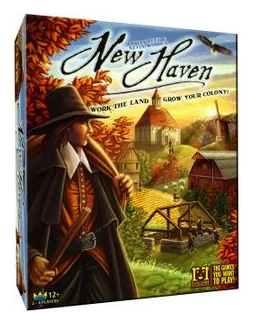
In New Haven, set in colonial New England, players must develop the riches of the land and build a thriving settlement. Players place tiles strategically to a shared game board to cut timber, quarry stone, plant fields of wheat, and fill pastures with fat sheep.
Core mechanisms
Key systems that shape the decisions players make.
Read the full game description
In New Haven, set in colonial New England, players must develop the riches of the land and build a thriving settlement. Players place tiles strategically to a shared game board to cut timber, quarry stone, plant fields of wheat, and fill pastures with fat sheep. Players then use these resources to erect buildings on their own village boards, attempting to complete rows and columns for population points. Whoever can build the biggest and most prosperous town will end up with the biggest population and win the game! New Haven is a tile-laying game with a drafting component. The center board is the land between the player villages from which resources will be gathered. Players select from their two hidden tiles and play on this board to generate available value in some of the four resources. Once per game, each player can get a shipment which delivers a large value of one specific resource type. This value is then used by the player to play building tokens on his personal village board. However, he can play only building tokens already owned behind his player screen, with restrictions on how buildings must be arranged. He can elect to play a token face down for more flexibility, but this means a lower score if he successfully completes that row or column of buildings. Once a player is done building, any value he hasn't used is available for his opponents to use to build! Thus, the goal when placing resource tiles is to generate just enough for what is needed, not the most that can possibly be created. Finally, the player drafts new building tokens for use on future turns; plan your creation and consumption of resources to perfectly match your needs, and you'll be rewarded with additional tokens. The base game lasts ten turns, and the player who attracts the most colonists to his village by completing roads and avenues of buildings wins the game. New Haven plays well with 2, 3, or 4 players, lasting about 15 minutes per player, with a bit more time needed for learning games. The game includes a side B game board with some twists, as well as rule variants that can make the gameplay either more forgiving or more strategic.