Overview
At a glance
Is this game right for my group?
ABG editorial scores on a 1–5 scale.
Harder to teach
High replayability
Low interaction
Scales well
Deep strategy
How it plays
How does it play?
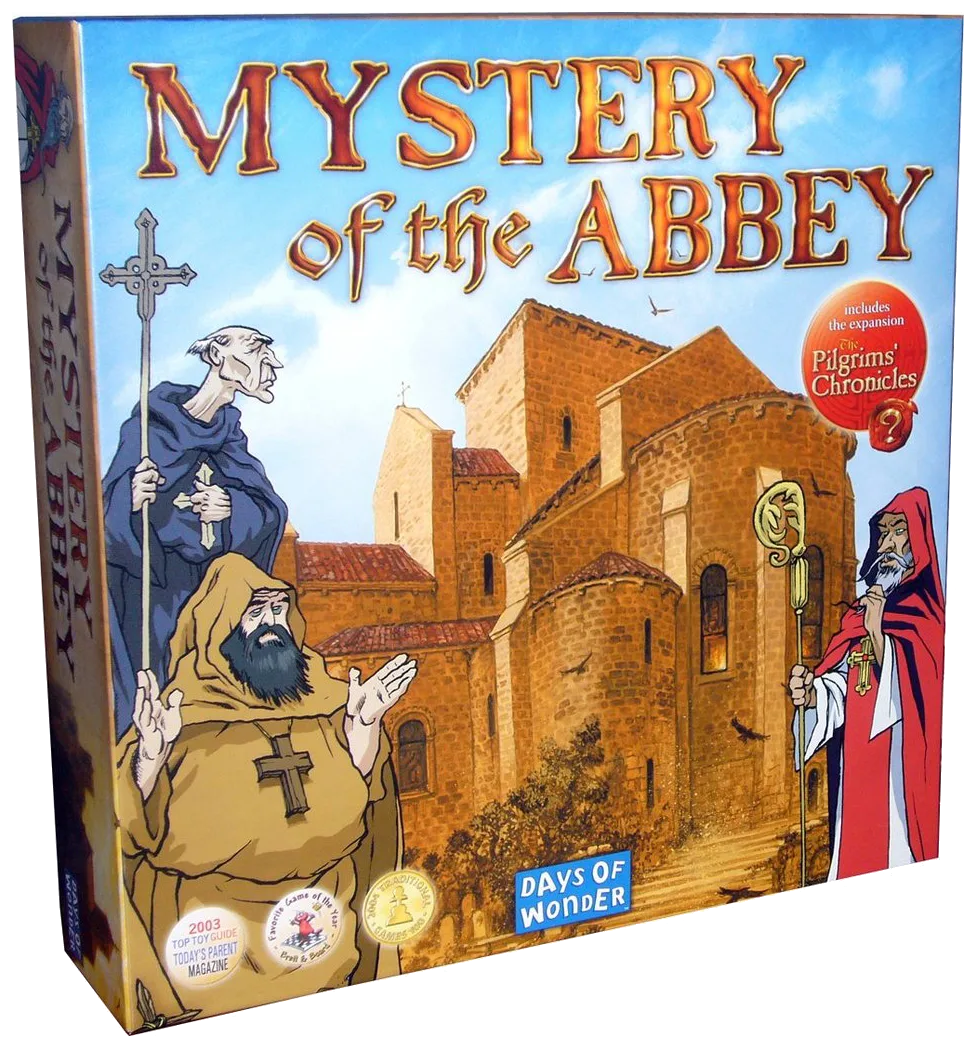
Mystery of the Abbey is a whodunit deduction game in the spirit of Clue. A monk has been murdered in a medieval French Abbey.
Core mechanisms
Key systems that shape the decisions players make.
Area Movement
Move pieces between connected regions rather than along individual spaces.
Dice Rolling
Roll dice to introduce uncertainty into actions, production, movement, or resolution.
Hand Management
Time and sequence a limited hand of cards to preserve future options.
Set Collection
Gather related items that become more valuable when scored together.
Paper-and-Pencil
Record choices and results directly on a personal sheet.
Events
Triggered events alter the shared state, rules, or available choices.
Read the full game description
Mystery of the Abbey is a whodunit deduction game in the spirit of Clue. A monk has been murdered in a medieval French Abbey. Players maneuver their way through the Abbey examining clues and questioning each other to find out who is the culprit. Monks are of three orders, fat-thin, bald-hatted, bearded-clean shaven. One monk card is hidden, and the rest of the cards are distributed. Turns consist of moving up to two spaces, and then asking a question of any other monks who are present there. (For instance, "how many fat monks do you have?".) Players may either take a "vow of silence" or answer truthfully; they then in turn get to ask the accuser a question. "Mass" occurs every four turns: all players go back to the Sanctuary, an event card is read, and they then pass an ever growing number of cards to their left neighbor. Various rooms have special events or cards associated with them, e.g. in a Cell you get to pick a card from a neighbor, in the Cryptorum you get to pick up a card to take an extra turn later. Unlike Clue you don't automatically win by making a correct Accusation: you get 4 points for getting it right, but you also get 2 points for each correct Declaration of a single trait, and lose points for incorrect declarations and accusations. So, e.g. a person could correctly Declare the culprit but lose the game. Unique Events cards add randomness to each play, and the game begs for House rules to limit the questions.