Overview
At a glance
Is this game right for my group?
ABG editorial scores on a 1–5 scale.
Harder to teach
High replayability
Low interaction
Scales well
Deep strategy
How it plays
How does it play?
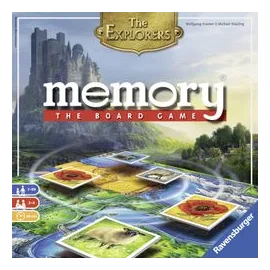
Memory: The Board Game features the familiar Memory gameplay, with players turning over two tiles on their turn and collecting those tiles if they match (and returning them face-down otherwise), but in this game collecting the most pairs does not guarantee victory!
Core mechanisms
Key systems that shape the decisions players make.
Read the full game description
Memory: The Board Game features the familiar Memory gameplay, with players turning over two tiles on their turn and collecting those tiles if they match (and returning them face-down otherwise), but in this game collecting the most pairs does not guarantee victory! No, the tiles are laid out on a game board that features a multicolored background — green for forests, blue for lakes, etc. — and after you collect tiles, you can choose to return tiles face-up to the board if the background color of the tile matches the color of the spaces being covered. When you do this, you score 1-4 points based on how many tiles you return; these points are represented by tree segments, with the 4-point tree segment being taller than four 1-point segments. When the last pair of tiles is removed from the board, players compare the height of their trees, and whoever has the tallest tree wins.