Overview
At a glance
Is this game right for my group?
ABG editorial scores on a 1–5 scale.
Harder to teach
High replayability
Highly interactive
Scales well
Deep strategy
How it plays
How does it play?
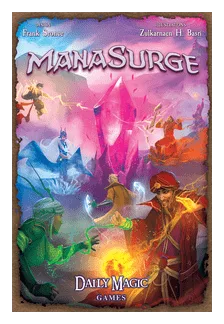
ManaSurge is a competitive magical card game in which dueling wizards fight for possession of the mystical World Crystal, a valued relic among magic users that grants immense power to whichever wizard wields it.
Core mechanisms
Key systems that shape the decisions players make.
Read the full game description
ManaSurge is a competitive magical card game in which dueling wizards fight for possession of the mystical World Crystal, a valued relic among magic users that grants immense power to whichever wizard wields it. You are one of the many wizards who have come to claim the stone, but gaining control of the stone won’t be an easy task. This free-for-all magical showdown pits 2-6 wizards against each other over a series of rounds. Each round is a magical duel between all the wizards, which includes six different types of magic: Blades, Fireball, Frost Wave, Lightning, Quake and Metamagic. These magic types will aid wizards in their duel. Players take turns casting an initial spell that will set the rule for the round, set the rank other players must beat, and earn them a potential Shard (VP). Players then take turns playing cards of equal or higher rank from their hands to the table; if they match the spell suit, they place a Shard on that card. The round ends when a player can no longer play a valid card from their hand. The player that could not play a card returns any Shards on their played cards back to the center, then takes card damage equal to the amount of Shards that are still on cards. All other players then take the Shards on cards they played to their Victory Pool. The player who played the last card gets a bonus Shard. When a player takes damage, they draw cards from the deck equal to the amount of damage and place them face down in front of them. If they ever accumulate 5+ damage, they immediately discard their hand and a Shard, then take their damage cards in to their hand. The game ends when one player has enough Shards. 15 in a two-player game, 12 for three or four players, and 10 for five or six.