Overview
At a glance
Is this game right for my group?
ABG editorial scores on a 1–5 scale.
Harder to teach
High replayability
Highly interactive
Scales well
Deep strategy
How it plays
How does it play?
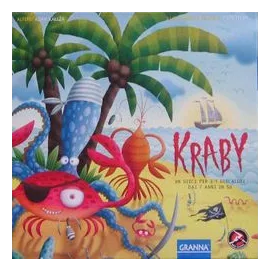
Time to catch some crabs! Not for dinner, mind you, but to sell to markets for a grand haul.
Core mechanisms
Key systems that shape the decisions players make.
Pattern Building
Place elements to create arrangements that satisfy scoring or action patterns.
Enclosure
Surround spaces or pieces to claim territory, capture, or score.
Hand Management
Time and sequence a limited hand of cards to preserve future options.
Stock Holding
Acquire shares whose value depends on companies, assets, or player actions.
Tile Placement
Place tiles to build a shared or personal spatial arrangement.
Read the full game description
Time to catch some crabs! Not for dinner, mind you, but to sell to markets for a grand haul. In order to make the most for your efforts, you want to concentrate on those crabs grouped together in large sets. Otherwise you're piddling away time spent chasing individual crabs, which is hardly worth the bother. The fishermen who nets the most valuable haul wins the game. Set-up in Kraby differs depending on the number of players, with 80 or 120 tiles in play, the game board being 9x9 or 11x11, and the number of colored crab figures being 10, 12 or 15. Each player starts by secretly drawing six crab tiles (which come in four colors with two players and five colors otherwise) and placing them behind their screen. On a turn, a player chooses one tile and enters it from any side of the game board, sliding it in the row or column until it hits the island at the center of the board or another tile in play. (A move that would slide a tile off the board or create an impossible-to-fill space is illegal.) The player then draws a new tile and places it behind his screen. A player then has the option of placing one of the colored crab figures in his ship's hold. Each ship has three holds, with a scoring multiplier of x1, x2 or x3. A player can claim a color only once and cannot place it on the same multipler as another player. In a four-player game, a player can claim only two figures.) The game ends once the final tile has been placed and the game board filled. Each group of crabs in the same color, with orthogonally adjacent crabs belonging to the same group, is worth -1 to 5 points depending on its size. Once the value of a color is determined, each player scoring this color multiplies this value – which might be negative – by the multipliers showing on his ship's hold. The player with the highest score wins.