Overview
At a glance
Is this game right for my group?
ABG editorial scores on a 1–5 scale.
Harder to teach
High replayability
Highly interactive
Scales well
Deep strategy
How it plays
How does it play?
Linked game discovered from BGG. Full scrape pending.
Core mechanisms
Key systems that shape the decisions players make.
Push Your Luck
Choose whether to secure current gains or risk them for a larger reward.
Dice Rolling
Roll dice to introduce uncertainty into actions, production, movement, or resolution.
Hand Management
Time and sequence a limited hand of cards to preserve future options.
Worker Placement
Commit limited workers to action spaces before opponents occupy them.
Take That
Direct negative effects at selected opponents.
Read the full game description
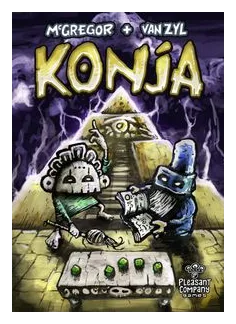
Description from the publisher: Konja is a press-your-luck and resource management dice game in which 2 players compete as wizards, summoned by an old king to manifest a great storm and bring rain to a dry land. By rolling dice and activating powerful spells and relics cards, players gain Gold, Magick, Power, and Clouds. Konja is played over a series of rounds; in each round, each wizard completes their turn before play proceeds to their opponent. On their turn, a wizard first selects from the available Ancestors, which grants the active wizard a Favour, and both wizards a Blessing. Favours and Blessings consist of bonus actions including refreshing Spell cards in hand, buying and selling Relic cards and gaining Clouds. The active player then rolls the dice, and through manipulation of Relic and Spell cards, create useful dice combinations: Single die showing a high number reward Power tokens, which are used strengthen the effects of Relic cards. A pair of dice reward Magick tokens, which activate Spell cards in hand. Runs ( three or more dice showing consecutive numbers) reward Gold tokens, which are spent to purchase Relic cards from the Offerings and are sacrificed for Clouds. Three or more dice showing the same number gains Cloud tokens, which are worth points at the end of the game. The first wizard to accumulate 21 or more points worth of Clouds triggers the last round of the game. Once both wizards have completed their turn thr game ends and the wizard with the most points is declared the winner.