Overview
At a glance
Is this game right for my group?
ABG editorial scores on a 1–5 scale.
Harder to teach
High replayability
Highly interactive
Scales well
Deep strategy
How it plays
How does it play?
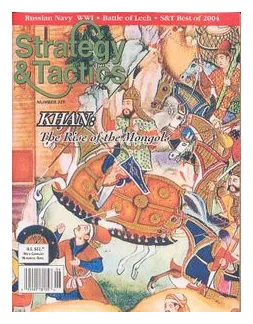
Khan: The Rise of the Mongol Empire, A.D.
Core mechanisms
Key systems that shape the decisions players make.
Read the full game description
Khan: The Rise of the Mongol Empire, A.D. 1206-1295 is a wargame simulating the rise of the Mongols from their origins as a minor nomadic tribe through their sweep across Eurasia, during which they conquered the prominent empires of the age and established a vast realm that stretched from China to Russia and the Middle East. The game has several scenarios, representing the initial Mongol explosion out of Central Asia, the later campaigns of consolidation in the era of Kublai Khan, and a grand scenario representing the entire era. Khan is a two-player game. The Mongol player controls the forces of the Mongols themselves, as well as their various subject peoples. The Kingdoms player controls various independent states and rebels who are opposed to the Mongols. The Mongol player, representing a single, centralized empire, has more direct control over his forces. The Kingdoms player, representing a range of sometimes competing powers, will find the game system causes various subordinate forces to enter and exit from his control at different times. Both player's forces are represented by military units and stratagem markers. Players must use a combination of military strength and cunning strategy to expand their power or defend their independence. Each game turn represents five years. Each hex is approximately 100 miles across. Each military unit represents 10,000 – 100,000 troops, plus pack animals, camp followers, bureaucrats, etc. Each leader represents a single great person or cadre of generals and officials, plus an elite bodyguard.