Overview
At a glance
Is this game right for my group?
ABG editorial scores on a 1–5 scale.
Harder to teach
High replayability
Highly interactive
Scales well
Deep strategy
How it plays
How does it play?
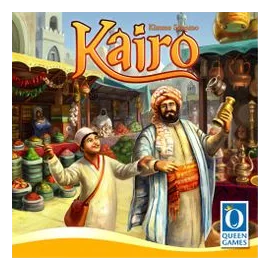
In the bustling market of Kairo, traders build their stalls and try to entice customers with attractive goods, with each customer bringing money that the trader can then use to expand that stall or establish new stalls.
Core mechanisms
Key systems that shape the decisions players make.
Grid Movement
Move pieces between adjacent spaces on a regular grid.
Hand Management
Time and sequence a limited hand of cards to preserve future options.
Open Drafting
Select cards or items from a shared face-up display.
End Game Bonuses
Earn additional points for meeting conditions evaluated when the game ends.
Square Grid
Use an orthogonal grid where position and adjacent spaces shape movement or placement.
Read the full game description
In the bustling market of Kairo, traders build their stalls and try to entice customers with attractive goods, with each customer bringing money that the trader can then use to expand that stall or establish new stalls. To set up Kairo, players first take turns placing three colored stalls (out of six) on the game board. They also take three stall cards (which highlight one or more sections on the game board) and one coin of each of the six colors. Five colored customers start at particular locations on the game board, with the sixth customer placed to the side. On a turn, a player either: Draws two cards (face-up or face-down stall cards or market barker cards). Moves a customer to a stall of that customer's color. Plays a stall card; then builds a new stall, expands an existing stall, or moves a blocked-off stall. The active player can choose to move any customer, and that customer will move to the closest stall (measured on orthogonal paths) of the same color. Additionally, this player can choose to play one or more market barker cards to "call" the customer past one or more stalls, presumably to bring the customer to that player's own stall. If the active player owns the visited stall, he receives one coin of the stall's color for each tile in that stall; if not, the active player receives a one coin commission while the owner receives the normal payout. This customer is then swapped with the customer off the board. When building a new stall, a player cannot place it in the same region as another stall of the same color. Regulations! Restaurants must be placed in an area designated for them, while all other stalls must go in the market area. When expanding an existing stall, the player must pay one coin of the same color for each tile in the enlarged stall. By expanding, you can earn more coins when customers visit, create longer paths to opponents' stalls, reserve area in which to expand further, and (most importantly) earn victory points. You score VPs each time you expand, and if your stall is the largest (or tied for the largest) of that color, you'll take one or two medals that provide a VP bonus. Once the expansions run low in one or two colors, players can only build or expand. Once everyone has finished building, the game ends, with players earning VPs for the medals and money they have in hand. The player with the most points wins.