Overview
At a glance
Is this game right for my group?
ABG editorial scores on a 1–5 scale.
Harder to teach
High replayability
Highly interactive
Scales well
Deep strategy
How it plays
How does it play?
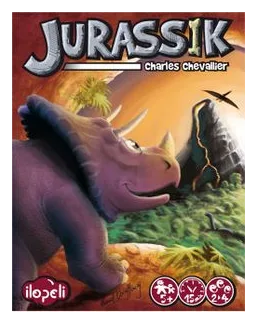
In Jurassik, players are paleontologists on a dig looking for dinosaur bones. Ideally you want to collect bones for the same type of dinosaur so that you can assemble a complete skeleton!
Core mechanisms
Key systems that shape the decisions players make.
Read the full game description
In Jurassik, players are paleontologists on a dig looking for dinosaur bones. Ideally you want to collect bones for the same type of dinosaur so that you can assemble a complete skeleton! At the start of the game, the 32 dinosaur cards (four cards each of eight different dinosaurs) are shuffled with one "start excavations" card and 15 randomly-chosen action cards from a total of 22. A player shuffles these cards, lays them out in a 6x8 rectangle, then removes the start excavations card to show where the dig begins. On a turn, a player reveals any card that has at least one edge adjacent to the digging area. Dinosaur and action cards have different backs, so the player knows what type of card he draws, but not which card exactly. If she draws a dinosaur card, she places it face-up in front of her. If she draws an action card, she may be able to take a second turn, steal from another player, or force an exchange of one bone for another; she may also be forced to discard a card, or she might end up with a rock, which is placed back in the dig area for everyone to work around. When a player has four cards of the same dinosaur, she groups them as a set; these cards cannot be lost or stolen. The game ends when the final dinosaur card is collected. Players score 1, 3, 6 or 10 points for a set of 1-4 dinosaur cards of the same type, and the player with the most points wins.