Overview
At a glance
Is this game right for my group?
ABG editorial scores on a 1–5 scale.
Harder to teach
High replayability
Highly interactive
Scales well
Deep strategy
How it plays
How does it play?
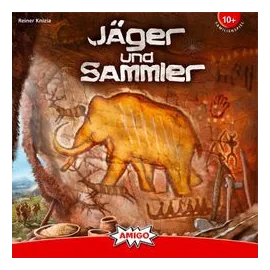
Jäger und Sammler is set in the Stone Age. Every player has control over a tribe of 4 hunter/gatherers.
Core mechanisms
Key systems that shape the decisions players make.
Grid Movement
Move pieces between adjacent spaces on a regular grid.
Enclosure
Surround spaces or pieces to claim territory, capture, or score.
Set Collection
Gather related items that become more valuable when scored together.
Memory
Remember previously revealed information, positions, or sequences.
Read the full game description
Jäger und Sammler is set in the Stone Age. Every player has control over a tribe of 4 hunter/gatherers. The game consists of two main phases: The summer phase and the winter phase. The aim of the game is to collect as many tiles as possible. Players have two movement points per turn and are only allowed to move to untaken tiles. When a player leaves a tile he gets to take it and place it in front of him. Food and artifacts are kept face down, but weapons and mammoths are kept face up. Whoever hunts down the biggest mammoth in the summer phase will start the winter phase. Players also have to visit the four winter camps during the summer to store supplies for the upcoming winter. If a player is not able to visit all four camps during summer, he will have fewer hunters in the winter phase. There are a lot of different tiles: - Food tiles score 1 to 3 points at the end of the game, depending on the type of food. - Rare and valuable artifact tiles increase in value depending on the number of identical tiles you collected. - Weapons are used to hunt down mighty mammoths. - Path-tiles remain on the board and guarantee a minimum amount of maneuverability. - Caves are connected with each other and may be used to cover big distances while moving. This game is based on the same prototype as Zombiegeddon.