Overview
At a glance
Is this game right for my group?
ABG editorial scores on a 1–5 scale.
Harder to teach
High replayability
Highly interactive
Scales well
Deep strategy
How it plays
How does it play?
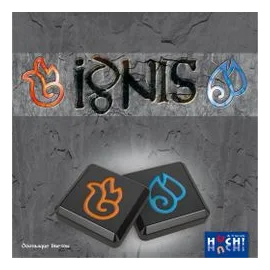
Fire and water! These two elements fight for supremacy in Ignis, and round by round players shove a piece into the playing area, trying to push off an opposing piece.
Core mechanisms
Key systems that shape the decisions players make.
Read the full game description
Fire and water! These two elements fight for supremacy in Ignis, and round by round players shove a piece into the playing area, trying to push off an opposing piece. If you use clever tactics, you might even finish off an entire row in one go! Which will win in the end: fire or water? The 6x6 game board starts with eight tiles of each player – one being fire, the other water – in a fixed arrangement. Twelve air tiles and nine earth tiles start play off the board; all of the non-earth tiles have earth on their reverse side. On a turn, a player takes a neutral tile from off the board and slides it onto an edge space, which means at the start of the game the 6x6 border. If this edge space is occupied, the neutral tile pushes those tiles before it. If a non-earth tile is pushed off the edge of the board, flip it to the earth side. Earth tiles can be moved, but they cannot be pushed off the board! If an outer edge of the playing area ever contains only tiles of the same element, remove these tiles from the board. These spaces are now off-limits on future turns. Thus, when the first edge is removed, pretend that the playing area is 5x6; when the second edge is removed, the playing area will be 4x6 or 5x5. Removing one row of tiles might cause another row to be removed afterward. As soon as either fire or water are eliminated from the playing area, the opposing player wins.