Overview
At a glance
Is this game right for my group?
ABG editorial scores on a 1–5 scale.
Harder to teach
High replayability
Highly interactive
Scales well
Deep strategy
How it plays
How does it play?
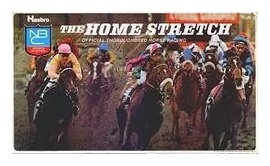
Horse racing game released by Hasbro and NBC (Yes, the US Television company) in a format nearly identical to the 3M plastic "wrap-around" boards. The Home Stretch is a horse racing game.
Core mechanisms
Key systems that shape the decisions players make.
Auction/Bidding
Bid against other players to determine who receives an item, action, or priority.
Betting and Bluffing
Risk resources on uncertain outcomes while disguising intentions or information.
Grid Movement
Move pieces between adjacent spaces on a regular grid.
Paper-and-Pencil
Record choices and results directly on a personal sheet.
Roll-and-Move
Roll dice or spin a dial to determine how far a piece moves.
Read the full game description
Horse racing game released by Hasbro and NBC (Yes, the US Television company) in a format nearly identical to the 3M plastic "wrap-around" boards. The Home Stretch is a horse racing game. The players represent the owners and jockeys of the horses in the race and the people betting on the race. To start the game, each player is given a certain amount of cash. This money is used to bid on horses. Each horse is represented by an "Ownership Card" which shows the horse's name, stable and "Speed". Speed is used to determine the likelihood of gaining an "Advantage" during the race. Bidding for each horse lasts three rounds and the high bidder gets the horse. Once the horses have been assigned their starting positions are determined and the Ownership Cards are placed in the "Readout Machine". This is a tray which holds the cards and will be used to determine movement. After all the horses are in the tray "Odds Cards" are placed below each Ownership Card. Odds Cards will determine the actual movement of each horse. Players may now make wagers on any horse they choose. Wagers may be made on any number of horses and may be made for Win, Place or Show. The player records their bets on a "Betting Slip" and places it face down on the board, then pays the total amount of the bets. To run the race the spinner is used to generate a random number. This number is used on the Readout Machine to determine the number of spaces moved and the "Diagonal Allowance" for each horse. Each Odds card has a column of numbers for total movement and a second column for Diagonal allowance. The Diagonal Allowance is the number of diagonal moves the horse may make and is therefore the number of times the horse can change lanes. The horse must use all of its movement but does not have to use all of its allowed lane changes. The spinner's random number determines which row of numbers on the Odds cards will be used in the current round for moving the horses along the track. Sometimes the spinner will indicate "Advantage". When this happens an Advantage card is drawn. Advantage Cards each show the name of one horse and that horse is allowed a free move of 6 with a diagonal allowance of 2. Other horses may not move. The better a horse's speed, the more Advantage Cards that horse has in the deck. The race continues until all of the horses have crossed the finish line. If more than one horse crosses the line in the same turn the horse which moves the furtherest past the finish line is the winner. The second and third place horse is determined the same way. Once all the horses have crossed the finish line the betting slips are revealed and winning wagers are paid. The players then set up the horses and the Readout Machine for the next race. Ownership of the horses remains the same but the starting order and Odds Cards change. A total of six races are run. The player with the most cash at the end of all six races is the winner. This is a very good game. Players can spend a good deal of money buying the best horses at the start of the game, but they then have less cash to place bets with. Meanwhile, other players can bet on their horses anyway. Also, the randomness of the appearance of the Advantage Cards mean that a good horse can have a bad showing and the slowest horse may come from behind to win. There is nothing to prevent a player from betting on another horse and racing theirs badly to influence the outcome but the other players may be doing the same thing and the fact that six races are run means that no one is likely to try it more than once (though it may show up as a race 6 strategy). A very interesting game.