Overview
At a glance
Is this game right for my group?
ABG editorial scores on a 1–5 scale.
Harder to teach
High replayability
Highly interactive
Scales well
Deep strategy
How it plays
How does it play?
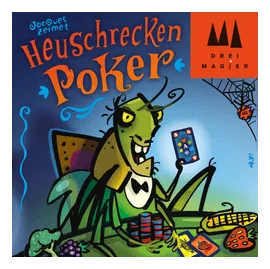
In Heuschrecken Poker (Grasshopper Poker), you want to cultivate the best garden you can without letting the grasshoppers wreck it. Each player starts with a hand of eight bidding cards: 1-6, an Ace, and an X.
Core mechanisms
Key systems that shape the decisions players make.
Read the full game description
In Heuschrecken Poker (Grasshopper Poker), you want to cultivate the best garden you can without letting the grasshoppers wreck it. Each player starts with a hand of eight bidding cards: 1-6, an Ace, and an X. Three cards from the garden deck are revealed, then all players choose a card from their hand and reveal them simultaneously. Whoever plays the highest card takes all cards of one type from the display, then whoever played the next highest card takes a type, etc. Cards come in five types: corn, strawberries, broccoli, blackberries, and grasshoppers. Place all plant cards together by type in your personal garden, with the grasshoppers at the top. If you have three cards of the same crop, remove them from play and take a point chip. If, however, you collect three grasshoppers in your garden, you must remove all cards from your garden and start again. If you play your Ace, you collect all cards on offer instead of only one type; if you play your X, you collect nothing — except if someone has played an Ace, in which case the X steals the power of the Ace and you collect everything. If two or more players reveal the same card, ignore those cards; if all cards are ignored, add another garden card to the pot and play again. In the event of another tie, discard all four cards and start another turn by refilling the display to three cards. After playing eight turns, whoever has the most plant cards in their garden scores a point chip, then everyone takes their bidding cards back in hand and starts a new turn. Once the garden deck is exhausted, the game ends and whoever has the most point chips wins.