Table feel
Haste Worte has a high level of direct confrontation and strategic depth in confrontation. Players need to frequently pay attention to and react to others' strategies and turns. However, there is less emphasis on cooperation in the game.
Players
3-8
Time
?-?
Age
8+
Weight
1.4
Rating
6.84
Teaching signal
High replayability
Highly interactive
Scales well
Deep strategy
Luck-sensitive
Haste Worte has a high level of direct confrontation and strategic depth in confrontation. Players need to frequently pay attention to and react to others' strategies and turns. However, there is less emphasis on cooperation in the game.
Haste Worte has a high variability gameboard, allowing for different experiences each time it is played. The presence of expansions adds new content and gameplay elements, further enhancing replay value. The game offers deep strategic possibilities and room for players to improve their strategy over time. The player interaction score is moderate, and the game scales well with different numbers of players. While it may take some time to learn, the game offers a good balance between easiness and depth. Overall, Haste Worte has a strong replayability score of 7.84.
Haste Worte has a moderate level of luck involved in the game. Random elements like dice rolls or card draws have a notable but not exclusive impact on the game outcome. However, players have substantial ability to mitigate the effects of randomness through strategic decisions and planning. The game outcome is a balanced mix of luck and strategy, with neither element dominating. Overall, Haste Worte offers a good balance between luck and player agency.
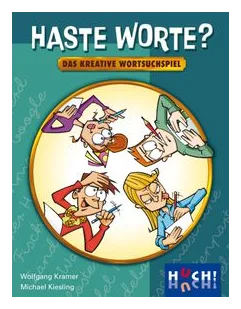
Haste Worte is a party/word game from Wolfgang Kramer and Michael Kiesling. Each turn players have 30 seconds to write as many answers for the category or question that round. After 30 seconds expire, players must bid on how many unique answers they have on their list. Bids are revealed simultaneously with players having the lowest bids reading their answers first. Any answer already named gets crossed of a players list before they get a chance to take their turn. Players score points equal to their bids if they make it and the first one around the board wins. In 2003 Spielzeit published a version of the game without a board. The board is built using the backs of some of the cards.
| Edition | Year | Language | Publisher / Region |
|---|---|---|---|
| No editions imported yet. | |||
No files imported yet.