Overview
At a glance
Is this game right for my group?
ABG editorial scores on a 1–5 scale.
Harder to teach
High replayability
Highly interactive
Scales well
Deep strategy
How it plays
How does it play?
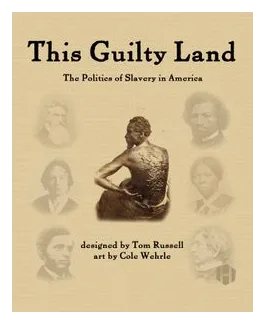
This Guilty Land is a game about the political struggle over slavery in the United States in the decades prior to the American Civil War.
Core mechanisms
Key systems that shape the decisions players make.
Read the full game description
This Guilty Land is a game about the political struggle over slavery in the United States in the decades prior to the American Civil War. The two players each represent an abstract idea - Justice and Oppression - while a third, non-player faction, Compromise, both helps and hinders them while seeking, insidiously, to maintain the untenable and abhorrent status quo. This is a card-driven game, but it's a rather atypical variation on that form. An Events Display contains cards belonging to both players and is public information. Cards played from the Events Display have effects depending on the type of card, and many cards can be placed into a player's Reserve, where they can be used throughout the game to take other sorts of actions. The size of one's Reserve is limited to the player's Organizational Capacity. This Capacity can be increased over the course of the game and also influences the strength of a player's actions, the minimum number of their cards drawn into the Display, and victory point opportunities. The game is asymmetrical in that each player's mix of cards within the deck either play to their strengths or emphasize their weaknesses. Like many of Ms. Holland's games, it is about deadlock, with each side countering the other until one of them blinks. Advantages multiply over time and a single mistake might make your position irrecoverable. Tempo and momentum are terribly important because, at its heart, this is a racing game. Both players score victory points for passing laws and forming political parties, and Justice scores victory points for growing support for their cause. Assuming neither player wins an instant victory by dominating the laws or reducing their opponents support to zero, the game ends when either the supply of victory points or the deck of cards is exhausted, and the player with the highest score wins. When the game ends, the American Civil War begins: the game's argument is that the Civil War was both inevitable and necessary, and through its mechanisms, the game seeks to illustrate why that is the case while still providing a deep and engaging play experience. -description from publisher