Overview
At a glance
Is this game right for my group?
ABG editorial scores on a 1–5 scale.
Harder to teach
High replayability
Highly interactive
Scales well
Deep strategy
How it plays
How does it play?
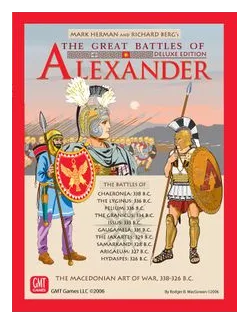
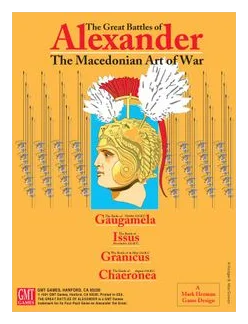
The Great Battles of Alexander contains four of the Macedonian conqueror's most famous and decisive battles, all chosen to highlight the developement of the Macedonian Art of War.
Core mechanisms
Key systems that shape the decisions players make.
Movement Points
Spend a movement allowance across spaces with different costs.
Dice Rolling
Roll dice to introduce uncertainty into actions, production, movement, or resolution.
Scenario Campaign
Play linked or standalone scenarios with their own setup, objectives, and consequences.
Hexagon Grid
Use a hexagonal map where each space connects evenly in six directions.
Combat Results Table
Compare opposing strength as a ratio, then consult a table to resolve combat.
Read the full game description
The Great Battles of Alexander contains four of the Macedonian conqueror's most famous and decisive battles, all chosen to highlight the developement of the Macedonian Art of War. The battles covered are: Chaeronea – August 338 BC Granicus – May 334 BC Issus – November 333 BC Gaugamela – October 331 BC The game mechanics use a combat system that emphasizes weapon/armor superiority and maneuverability over quantity. The battles can be fought separately or combined into a campaign version.