Overview
At a glance
Is this game right for my group?
ABG editorial scores on a 1–5 scale.
Harder to teach
High replayability
Highly interactive
Scales well
Deep strategy
How it plays
How does it play?
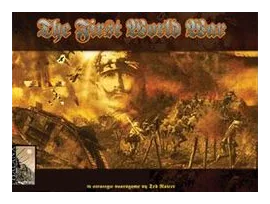
The game is by veteran designer Ted Raicer and contains: 1 hard mounted game board, 96 army counters (about an inch per side; incl.
Core mechanisms
Key systems that shape the decisions players make.
Area Majority
Compete to have the strongest presence in areas that award control or points.
Dice Rolling
Roll dice to introduce uncertainty into actions, production, movement, or resolution.
Point-to-Point Movement
Move along explicit connections between named locations or nodes.
Secret Unit Deployment
Place or assign units secretly before their positions are revealed.
Simulation
Model a real or imagined system through detailed cause-and-effect rules.
Read the full game description
The game is by veteran designer Ted Raicer and contains: 1 hard mounted game board, 96 army counters (about an inch per side; incl. 24 dummies), 46 City Victory markers, 30 Combat chits, 1 Game Turn marker, 1 Game Round marker, 4 Victory Point markers, 8 Game Order Determination markers, 4 Surrender markers, 1 Treaty of Brest-Litovsk marker, 2 Dice, 1 Rules Booklet (8 pages, full-color). The game board divides the map of Europe into three Theaters of War - the Western Theater, Italian Theater, and Eastern Theater. Each theater is sub-divided into two or more numbered Fronts (11 fronts total). Each front contains the location of one or more victory cities (46 in total). Ordinary victory city locations are shown with a box, color-coded to show the original owning faction. Replacement centers are shown by a circle in place of a box. Each front also contains one or more faction bases (hexagon shaped) which act as a special sort of city. Bases and cities within each Front are connected by Attack Lines which indicate which cities may be attacked. Finally each Front lists which armies may be deployed or moved there. The First World War can be played by 2 to 4 players. There are two Alliances: the Allies and the Central Powers. Each Alliance is divided into two factions. The Allies are divided into the Western Allied faction and the Eastern Allied faction. The Central Powers are divided into the German faction and the German Allied faction. Each faction consists of one or more nationalities.