Overview
At a glance
Is this game right for my group?
ABG editorial scores on a 1–5 scale.
Harder to teach
High replayability
Highly interactive
Scales well
Deep strategy
How it plays
How does it play?
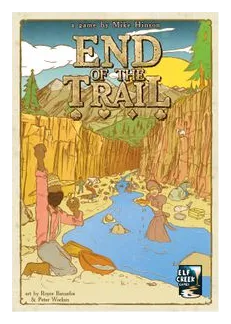
End of the Trail is a competitive card game for 1-4 prospectors and fortune seekers. Players manage a hand of cards to secure transportation, prospect land, and take a shot at winning a title to more land at the poker table.
Core mechanisms
Key systems that shape the decisions players make.
Auction/Bidding
Bid against other players to determine who receives an item, action, or priority.
Hand Management
Time and sequence a limited hand of cards to preserve future options.
Push Your Luck
Choose whether to secure current gains or risk them for a larger reward.
Set Collection
Gather related items that become more valuable when scored together.
Memory
Remember previously revealed information, positions, or sequences.
Modular Board
Build the play area from interchangeable sections that vary between games.
Read the full game description
End of the Trail is a competitive card game for 1-4 prospectors and fortune seekers. Players manage a hand of cards to secure transportation, prospect land, and take a shot at winning a title to more land at the poker table. Cards have three uses, each corresponding to a particular phase of the game: to prospect land tiles and discover how much gold a claim will produce, to collect and play cards that build a good poker hand, and to purchase additional cards in auction to help with prospecting, poker, or both. Prospecting land is a risky business. Players must choose their cards carefully, as they have limited chances to discover the most bountiful sources of gold. Each time they play a card and peek at a land tile, they must decide if they will stake a claim, placing their prospector’s tent, or if they will press their luck and try to find a better claim. But if a new land tile that they peek at produces less gold than their most previous inspected tile, the player’s luck has run out, and they are forced to accept the less bountiful claim. In the California Gold Rush, fortunes were won and lost at the poker table. At the end of each round, players must select two of the cards they played for prospecting and add them to the stud poker hand in front of them on the table. At the end of the game, players reveal their poker hands. The player with the best poker hand wins another claim, placing their fourth and final prospector’s tent on a land tile. At the end of the game, all hidden values are revealed and players add up the gold of their various claims. The player with the most gold wins. —description from the publisher