Overview
At a glance
Is this game right for my group?
ABG editorial scores on a 1–5 scale.
Harder to teach
High replayability
Highly interactive
Scales well
Deep strategy
How it plays
How does it play?
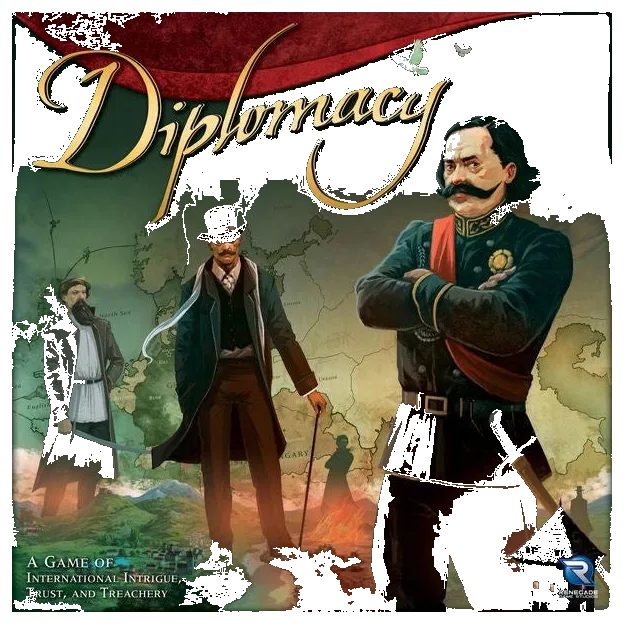
This classic game of pure negotiation has taken many forms over the years. The first The Avalon Hill Game Co version has perhaps the widest release, but Avalon Hill re-released the game in 1999, complete with a colorful new map and metal pieces.
Core mechanisms
Key systems that shape the decisions players make.
Area Majority
Compete to have the strongest presence in areas that award control or points.
Area Movement
Move pieces between connected regions rather than along individual spaces.
Negotiation
Make proposals, promises, or deals directly with other players.
Simultaneous Action Selection
Choose actions secretly or concurrently before revealing them together.
Player Elimination
Players can be removed from contention before the game ends.
Prisoner's Dilemma
Choose whether to cooperate or defect without knowing the other player’s decision.
Read the full game description
This classic game of pure negotiation has taken many forms over the years. The first The Avalon Hill Game Co version has perhaps the widest release, but Avalon Hill re-released the game in 1999, complete with a colorful new map and metal pieces. In 2008, Avalon Hill released a 50th anniversary edition with a new map and cardboard pieces representing the armies and navies. In the game, players represent one of the seven "Great Powers of Europe" (Great Britain, France, Austria-Hungary, Germany, Italy, Russia or Turkey) in the years prior to World War I. Play begins in the Spring of 1901, and players make both Spring and Autumn moves each year. There are only two kinds of military units: armies and fleets. On any given turn, each of your military units has limited options: they can move into an adjoining territory, support an allied unit in an attack on an adjoining territory, support an allied unit in defending an adjoining territory, or hold their position. Players instruct each of their units by writing a set of "orders." The outcome of each turn is determined by the rules of the game. There are no dice rolls or other elements of chance. With its incredibly simplistic movement mechanics fused to a significant negotiation element, this system is highly respected by many gamers. Avalon Hill Complexity rating - 3 Re-implemented by: Colonial Diplomacy Diplomacy: Classical Variant Diplomacy: Hundred Variant