Overview
At a glance
Is this game right for my group?
ABG editorial scores on a 1–5 scale.
Harder to teach
High replayability
Highly interactive
Scales well
Deep strategy
How it plays
How does it play?
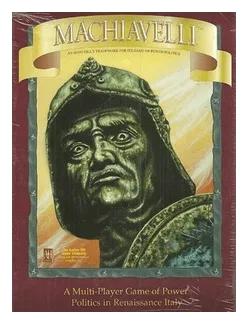
Machiavelli recreates the historical situation of the fast developing and ever shifting balance of power struggle in Renaissance Italy.
Core mechanisms
Key systems that shape the decisions players make.
Area Movement
Move pieces between connected regions rather than along individual spaces.
Dice Rolling
Roll dice to introduce uncertainty into actions, production, movement, or resolution.
Simultaneous Action Selection
Choose actions secretly or concurrently before revealing them together.
Player Elimination
Players can be removed from contention before the game ends.
Variable Player Powers
Each player has different abilities, restrictions, or strategic advantages.
Simulation
Model a real or imagined system through detailed cause-and-effect rules.
Read the full game description
Machiavelli recreates the historical situation of the fast developing and ever shifting balance of power struggle in Renaissance Italy. There are five major powers: The Republics of Florence and Venice, the Duchy of Milan, the Kingdom of Naples and the Papacy (which was a secular power in this era) along with 3 major foreign powers: Valois France, Hapsburg Austria and the Ottoman Turks. All of these states singly or in combination compete for control of the peninsula. Expanded by: Alea Magazine nº22 contained seven new scenarios for Machiavelli.