Overview
At a glance
Is this game right for my group?
ABG editorial scores on a 1–5 scale.
Harder to teach
High replayability
Highly interactive
Scales well
Deep strategy
How it plays
How does it play?
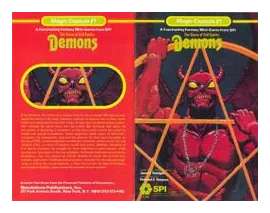
(from the instruction manual) Demons is a game of demonic conjuration and treasure hunting for one to four players based on the medieval and ancient manuscripts comprising the "Lamegeton." The players take the roles of magicians questing after treasure in medieval Armenia.
Core mechanisms
Key systems that shape the decisions players make.
Grid Movement
Move pieces between adjacent spaces on a regular grid.
Dice Rolling
Roll dice to introduce uncertainty into actions, production, movement, or resolution.
Movement Points
Spend a movement allowance across spaces with different costs.
Events
Triggered events alter the shared state, rules, or available choices.
Hexagon Grid
Use a hexagonal map where each space connects evenly in six directions.
Read the full game description
(from the instruction manual) Demons is a game of demonic conjuration and treasure hunting for one to four players based on the medieval and ancient manuscripts comprising the "Lamegeton." The players take the roles of magicians questing after treasure in medieval Armenia. The "mortal powers" of Armenia automatically pursue the magicians whose major defense is their ability to conjure fearsome demons. (paraphrased from the Historical Notes section of the instruction manual) The basic story of the key of Solomon holds that when Solomon was building the first temple in Jerusalem, one of his workers was seized by an evil spirit. The archangel Michael appeared and delivered to Solomon a magical ring which gave him the power to command all spirits. Solomon commanded the spirits into a brass vessel, which he sealed and cast into a lake in Babylonia. Solomon had foreseen the possibility of the demons being released again and had prepared a testament detailing the various rituals and instruments that could be prepared by any person to command the spirits once more. This power was to have been used for curing disease and preventing harm, but when printed examples appeared again in the 17th century the emphasis had switched to the finding of treasure and personal gain by the magician instead.