Overview
At a glance
Is this game right for my group?
ABG editorial scores on a 1–5 scale.
Harder to teach
High replayability
Highly interactive
Scales well
Deep strategy
How it plays
How does it play?
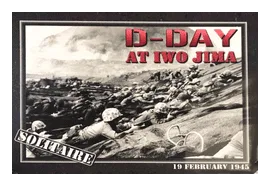
Description from the publisher: D-Day at Iwo Jima is a Solitaire wargame simulating the amphibious invasion of Iwo Jima. The five-week battle was some of the bloodiest fighting in the Pacific.
Core mechanisms
Key systems that shape the decisions players make.
Grid Movement
Move pieces between adjacent spaces on a regular grid.
Campaign Card Play
Play cards to command conflicts and carry consequences through a campaign.
Dice Rolling
Roll dice to introduce uncertainty into actions, production, movement, or resolution.
Simulation
Model a real or imagined system through detailed cause-and-effect rules.
Hexagon Grid
Use a hexagonal map where each space connects evenly in six directions.
Solo / Solitaire Game
Provide rules and objectives designed for a single player.
Read the full game description
Description from the publisher: D-Day at Iwo Jima is a Solitaire wargame simulating the amphibious invasion of Iwo Jima. The five-week battle was some of the bloodiest fighting in the Pacific. In one of the costliest intelligence failures of the war, the planners had completely misjudged the situation that would face the Marines. The beaches had been described as excellent and the advance inland was expected to be easy. Instead, the Marines were faced with 15-foot-high slopes of soft black volcanic ash that brought the normally rapidly moving Marines down to a slow plod. In addition, the lack of a vigorous response led the Marines to believe that the bombardment had completely suppressed the defenses. However, Gen. Kuribayashi was far from beaten. Understanding that his forces were insufficient to defeat the massive American invasion force, he had decided to defend the island in-depth. In D-Day at Iwo Jima, designer Joe Youst builds on John Butterfield’s award winning solitaire game system. The player controls three US Marine divisions against a determined Japanese defense. The no-dice combat system highlights the unknown enemy deployments and coordination of the right weapon systems and tactics. Players familiar with the previous three games in the system will be able to quickly set up and play this latest version. New features include a random fortification generation system that simulates the ability of the Japanese forces to “re-fortify” supposedly weakened positions and an updated infiltration system that encourages the player to maintain a continuous line. Scenarios: D-Day (19 February) – Covers the first day in six turns. Surabachi (20 to 24 February) – The 28th Marine Regiment’s capture of Surabachi. Drive to the North (20 to 24 February) – The attack on Airfield One and advance by the 4th and 5th Marine Divisions. Hot Rocks (25 February to 4 March) – The attack to clear the Motoyama Plateau. Drive to the Sea (6 to 10 March) – The final attack on the plateau and the end of organized Japanese resistance. Sands of Iwo Jima Campaign (19 February to 11 March) – The campaign combines all aspects of the previous scenarios into one look at the entire campaign. Game Contents: 528 Die-cut counters One 34” x 22” Mounted Game Board One 11” x 17” Set-Up Map Player Aid Cards Color Rules booklet Color Campaign Analysis 55 Event cards