Overview
At a glance
Is this game right for my group?
ABG editorial scores on a 1–5 scale.
Harder to teach
High replayability
Highly interactive
Scales well
Deep strategy
How it plays
How does it play?
Linked game discovered from BGG. Full scrape pending.
Core mechanisms
Key systems that shape the decisions players make.
Action Queue
Place actions into an ordered queue that resolves now or on later turns.
Communication Limits
Rules restrict what players may say, show, or reveal while cooperating.
Cooperative Game
Players coordinate their actions toward a shared objective and win or lose together.
Grid Movement
Move pieces between adjacent spaces on a regular grid.
Hand Management
Time and sequence a limited hand of cards to preserve future options.
Read the full game description
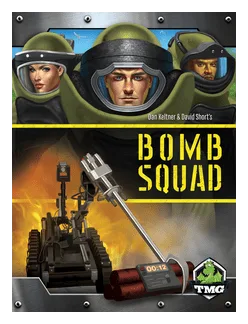
The sergeant hangs the phone up. "Multiple hostages, numerous bombs. We're up." We grab our gear, prep the robot and load the van. It's go time... An unknown terrorist organization is on the rise, looking to spread fear while profiting from the chaos they release. You, your fellow members of the Retro City Bomb Squad, and your trusty Bomb Squad Robot are the only barriers in the way between those dastardly villains and the innocent civilians of Retro City. Lives are at stake — and time is ticking — so let's go! Bomb Squad is a cooperative game in which 2-6 players are members of a team operating a disposal robot with the mission to disarm bombs and save hostages. The players work together, racing against the clock to provide the appropriate instructions for the robot to achieve their mission objectives. Bomb Squad features: Real-time play: Players each take a turn in clockwise order and are free to take as long as they want on their turn. However, there is a timer counting down in real time until the bombs will detonate, so players will want to be as efficient as possible. Hidden Card Information: Players hold their cards so that the fronts are facing the other players, which requires that players give each other Intel to figure out which cards they have in hand. Limited Communication: While players have their cards up and visible to each other, players are allowed to communicate only via the Intel they give each other, which provides hints about the cards they have in their hands. Table talk about which cards are needed, or where the robot should go, and giving implied hints about which cards to play are prohibited. Co-operative game play: The players all work together, winning or losing collectively as a team.