Overview
At a glance
Is this game right for my group?
ABG editorial scores on a 1–5 scale.
Harder to teach
High replayability
Highly interactive
Scales well
Deep strategy
How it plays
How does it play?
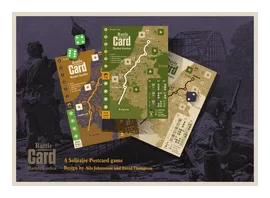
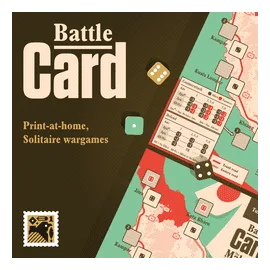
Battle Card: Series 1 is a collection of print at home micro solitaire games that depict iconic battles and campaigns of the Second World War with only a single sheet of paper and a handful of dice.
Core mechanisms
Key systems that shape the decisions players make.
Scenario Campaign
Play linked or standalone scenarios with their own setup, objectives, and consequences.
Dice Rolling
Roll dice to introduce uncertainty into actions, production, movement, or resolution.
Point-to-Point Movement
Move along explicit connections between named locations or nodes.
Solo / Solitaire Game
Provide rules and objectives designed for a single player.
Read the full game description
Battle Card: Series 1 is a collection of print at home micro solitaire games that depict iconic battles and campaigns of the Second World War with only a single sheet of paper and a handful of dice. Each scenario is played on a single sheet map with scenario-specific rules that allow players to face some of the unique challenges and struggles of that particular battle. In each scenario the player takes the role of one of the powers from the Second World War, trying to achieve historic goals. Each scenario focuses on different aspects of conflict, such as supply, artillery support, and fighting withdrawals. Scenarios take place across a wide range of theaters, from Western Europe to the Eastern Front, North Africa, and the Pacific. The games are played over a series of six turns, and while each game features unique choices, the player is often forced to make difficult decisions on whether to attack or defend, how best to bolster their main forces with support such as reinforcements and artillery, and when to advance or withdraw from conflict. Players need only print a single sheet of paper, grab a handful of dice, and can play right away. Each game takes only a few minutes to set up and learn the rules and can be played in 10 minutes or less. —description from the designer