Overview
At a glance
Is this game right for my group?
ABG editorial scores on a 1–5 scale.
Harder to teach
High replayability
Highly interactive
Scales well
Deep strategy
How it plays
How does it play?
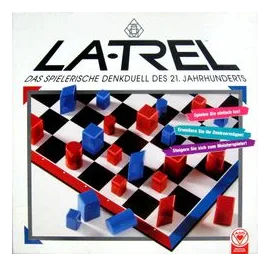
This game is 'Chess-like' in many ways: two players have identical sets of game pieces starting on opposite sides of a square grid. Players move one piece per turn and can eliminate the other player's pieces by moving into their space.
Read the full game description
This game is 'Chess-like' in many ways: two players have identical sets of game pieces starting on opposite sides of a square grid. Players move one piece per turn and can eliminate the other player's pieces by moving into their space. Movement options depend on which piece it is you're moving. In a fit of conspicuous difference, it's the black side who makes the opening move here. The central gimmick is that each piece is composed of two parts, a body and a head. The height of the body determines how far a piece can move (one, two or three spaces), whereas the head determines the directions: straight lines (like rooks), diagonals (like bishops), or both (like kings or queens). Each side also has one super-powered queen/rook hybrid which can move to any space within the range determined by its body, and even one unbeatable but immobile head. There's a reason for all this separation into bodies and heads: after every move the piece which just moved must swap heads with a different type of head, chosen by the player from their pieces still in play. There are two victory conditions: either you move one of your pieces to a specific target square on the far side of the board, or you force your opponent to make an illegal move. Draws are possible, but rare (they require both sides' forces to be extremely depleted). The theme is pretty much irrelevant - this is an abstract at heart. The rulebook frames the game as the secret strategy-honing tool of the nobles in a fictional culture, and the rules introduction is presented in dialogue form with the Wise Old Master teaching the game to his Young Noble Student, but none of this is at all relevant to gameplay. In fact, the game presented within the fiction is themeless and, quite literally, abstract: the pieces' names are translated as abstract concepts like 'strength' etc.