Overview
At a glance
Is this game right for my group?
ABG editorial scores on a 1–5 scale.
Harder to teach
High replayability
Highly interactive
Scales well
Deep strategy
How it plays
How does it play?
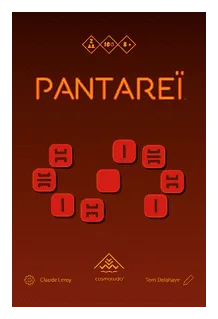
Your challenge in Pantareï is to be the first player to create a stack of seven pieces, but the more the game progresses, the more limited your choices become. Try to ensure that your choices will be better than the opponent's!
Read the full game description
Your challenge in Pantareï is to be the first player to create a stack of seven pieces, but the more the game progresses, the more limited your choices become. Try to ensure that your choices will be better than the opponent's! Each player has nine pieces, either black or white, with three pieces each of 1, 2, or 3 markings. The game includes one neutral piece. Shuffle the pieces with the markings hidden, then place them in a wiggly snakelike row, then reveal the markings. One player chooses the color they want, then the other player takes the first turn. On a turn, choose a stack that you control — that is, that has one of your pieces on top — then move the topmost piece of that stack or the top two pieces of that stack left or right a number of spaces equal to the number of markings on that piece. As you create gaps in the row, you can squish the stacks closer to one another to create a shorter snake. Instead of moving a piece or a stack of two pieces, you can choose two stacks that you control and swap them. (You cannot swap stacks if the opponent swapped stacks on their previous turn.) The neutral piece can be landed on, and it becomes part of a stack. As soon as someone creates a stack of seven pieces, they win!