Overview
At a glance
Is this game right for my group?
ABG editorial scores on a 1–5 scale.
Harder to teach
High replayability
Highly interactive
Scales well
Deep strategy
How it plays
How does it play?
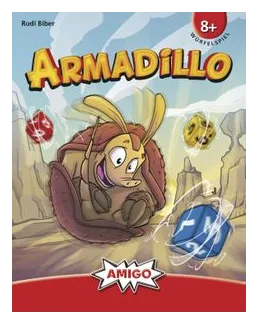
In Armadillo, you want to rid yourself of cards as quickly as you can through luck and smart choices over which armadillos — I mean, dice to roll each round. Each player starts the game with ten cards randomly numbered from 1 to 20, as well as two chips.
Core mechanisms
Key systems that shape the decisions players make.
Read the full game description
In Armadillo, you want to rid yourself of cards as quickly as you can through luck and smart choices over which armadillos — I mean, dice to roll each round. Each player starts the game with ten cards randomly numbered from 1 to 20, as well as two chips. On a turn, roll whatever combination of the six dice you like, with the two blue dice being numbered 1-3, the two yellow 4-6, and the two red 7-9. If the sum of the rolled dice matches a numbered card you have in hand, discard it! Of course, if someone else has that number, they discard it, too. You can spend chips to raise or lower the rolled number, and if you spend four chips, you can discard any card! Wait, four chips? Yes, any time you don't discard a card on your turn, you gain a chip from the pool. The round ends as soon as someone empties their hand, and everyone else scores 1 point per card still in hand. Whoever has the fewest points after three rounds wins.