Overview
At a glance
Is this game right for my group?
ABG editorial scores on a 1–5 scale.
Harder to teach
High replayability
Highly interactive
Scales well
Deep strategy
How it plays
How does it play?
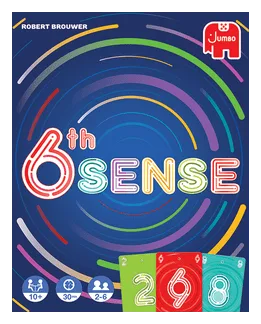
In the trick-taking card game 6th Sense, you score by correctly predicting the number of tricks you'll take in a round. The game lasts 4-6 rounds depending on the player count.
Core mechanisms
Key systems that shape the decisions players make.
Read the full game description
In the trick-taking card game 6th Sense, you score by correctly predicting the number of tricks you'll take in a round. The game lasts 4-6 rounds depending on the player count. The deck contains cards numbered 0-14 in five colors, and at the start of a round players are dealt a hand of 11-15 cards, then the top card of the deck is revealed to designate a trump suit. Each player then simultaneously chooses a card from their hand to predict the number of tricks they'll win this round, then places this card face down on the table. In general, standard trick-taking rules apply: Someone leads a card, and other players must follow suit, if possible, with the highest trump or highest card of the suit lead winning the trick. That said, some cards have special effects when played: When you play a 0, you can treat it as a 0 of that color, or you can remove the 0 and one previously played card from the current trick. A trick with a 4 in it is won by the lowest card played instead of the highest; a second 4 cancels this effect. The 6 and 9 are on the same card, and you declare which value you want when playing it (or when using it to predict the number of tricks you'll win). When you start a trick with an 8, you can peek at the prediction card of whoever wins that trick. If a trick contains at least one 12, the trick's winner can choose to immediately split the cards in that trick to count as two tricks. At the end of the round, if you've collected as many tricks as you predicted at the start of the round, you score that many points. If you failed to collect that number, you lose as many points as the difference between your prediction and what you collected, e.g., if you predicted 5 and collected 4 or 6 tricks, you lose 1 point. After the designated number of rounds, whoever has the most points wins.