Overview
At a glance
Is this game right for my group?
ABG editorial scores on a 1–5 scale.
Harder to teach
High replayability
Highly interactive
Scales well
Deep strategy
How it plays
How does it play?
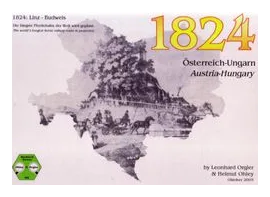
1824 Austria-Hungary is a railway building and share dealing game for 3-6 players. It is based on Francis Tresham's game 1829 and on Leonhard Orgler's game 1837.
Core mechanisms
Key systems that shape the decisions players make.
Auction/Bidding
Bid against other players to determine who receives an item, action, or priority.
Stock Holding
Acquire shares whose value depends on companies, assets, or player actions.
Network and Route Building
Create connected routes that improve reach, delivery, control, or scoring.
Tile Placement
Place tiles to build a shared or personal spatial arrangement.
Read the full game description
1824 Austria-Hungary is a railway building and share dealing game for 3-6 players. It is based on Francis Tresham's game 1829 and on Leonhard Orgler's game 1837. Historical realities have, as far as possible, been taken into account. In other places the history should and must be written anew. The player who has the greatest wealth in cash and shares at the end of the game is the winner. A set of simple mechanisms form the basis of 1824 Austria-Hungary. You use the yellow, green, brown and grey tiles to create a rail network on the map. Just as in a real railway business, the track in the game connects railway stations to each other. The trains (train cards) make notional journeys from one station to the next and thereby earn money. The (imaginary) passengers pay for their journeys. The more numerous and the more important the stations on a train's journey are, the more money it earns for the company and its shareholders. In the game you and your fellow players can own up to 6 Mountain Railways, 4 Coal Railways, 7 forerunners of the National Railways, as well as shares in 3 National Railways and 5 Regional Railways. The Major Companies (the National and Regional Railways) belong to their shareholders. The player with the most shares in the company is the Director of that company and decides how the company will act.