Overview
At a glance
Is this game right for my group?
ABG editorial scores on a 1–5 scale.
Harder to teach
High replayability
Highly interactive
Scales well
Deep strategy
How it plays
How does it play?
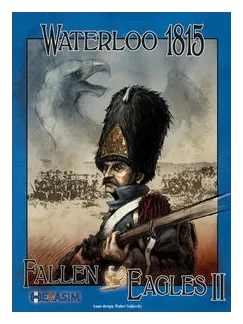
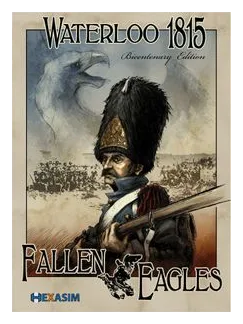
(in English, from the designer:) Waterloo 1815, Fallen eagles is a regiment/battalion level game of the famous battle.
Core mechanisms
Key systems that shape the decisions players make.
Grid Movement
Move pieces between adjacent spaces on a regular grid.
Dice Rolling
Roll dice to introduce uncertainty into actions, production, movement, or resolution.
Events
Triggered events alter the shared state, rules, or available choices.
Line of Sight
Visibility between pieces determines valid targets, movement, or effects.
Hexagon Grid
Use a hexagonal map where each space connects evenly in six directions.
Read the full game description
(in English, from the designer:) Waterloo 1815, Fallen eagles is a regiment/battalion level game of the famous battle. The game includes 400 counters (French, Anglo-allied and Prussian order of battle for June 18th 1815), a 108 x 75 cm map (200 meters per hexagon; 42.5 x 29.5 inches, in 2 parts), various play aids, a rule book and a playbook. It is a one hour of real time per turn game that can be completed in 5 to 10 hours of play. Beside the full battle game, several scenarios are available (Hougoumont, D'Erlon attack, Plancenoit). In addition, what if options will allow players to simulate alternate history variations to the battle. Fallen Eagles provides a detailed view of the battle but in a playable way. The focus is on morale, attrition and commitment of formation (division & corps) at the right time, rather than tactical chrome. The detailed order of battle and the scale of the game allow players to really see the action and the game system provides a quick but realistic resolution. A new system has been created and combat result tables have been tested against actual historical results of this battle. This system is a mix of well-known concepts and new features to maximize playability and realism of outcomes. Formation are given simple orders than limit their ability to freely react to any sudden change of priority. Orders take some time a while before being changed. Units are classically rated for size, quality and movement. Formations activate one after the other at player's choice but have to follow the order they received at the beginning of the turn or even before. Game features offensive fire, defensive fire, opportunity fire, charge and counter charge, retreat before combat and melee. A lot of classical "prohibitions" are transformed into options: for example, cavalry can move from ZOC to ZOC but risk counter charges or more opportunity fire. A ZOC of a strong unit is therefore not the same as the ZOC of a weaker one. The game turn has a random ending procedure and players are never sure to have time to move all their formation reflecting the command control issues of any battle. Also, the fatigue and friction factors are built in a potentially shorter turn length in the latter stages of the battle. Focus on morale and attrition is a testimony of a battle which was a test of will of two densely packed armies fighting head to head. Players will have to choose which unit will "lead" the attack and take the first fire. Failing a key morale test can make the difference between a stalled attack or a promising breakthrough. Game variations will include, for example, the Prussian arrival sooner or later than history, or a better weather the day before allowing for an earlier start of the french attack. Victory is determined with "sudden death" objectives given to both sides in order to simulate historical constraints but also by control of key objectives and losses at the end of the game. According to Wellington, Waterloo was a "near run thing". Will the thin red line hold against the French furia again? ================================================================(traduction française du texte anglais:) Waterloo 1815, la chute des Aigles est un jeu de niveau régiment / bataillon de la célèbre bataille. Le jeu comprend un peu plus de 400 pions (ordre de bataille français, anglo-allié et prussien du 18 Juin 1815), une carte 108 par 75 cm (200 mètres par hexagone), diverses aides de jeu, un livret de règle et un livret de jeu. L'échelle est d'une heure par tour et le jeu peut être terminé en 5 à 10 heures. En plus de la bataille complète, plusieurs scénarios sont disponibles (Hougoumont, d'Erlon attaque, Plancenoit). Des options permettront aux joueurs d'explorer des alternatives. La chute des Aigles propose une vue détaillée mais jouable de la bataille. L'accent est mis sur le moral, l'attrition et l'engagement des formations (division et corps) au moment opportun, plutôt que sur le chrome tactique. L'ordre de bataille détaillé et l'échelle du jeu permettent aux joueurs d'entrer dans l'action. Le système offre une résolution rapide mais réaliste des combats. Un nouveau système a été créé et les tables de combat ont été testés par rapport aux résultats historiques. Ce système est un mélange de concepts bien connus et de nouvelles fonctionnalités pour optimiser jouabilité et réalisme. Des ordres simples sont donnés aux formations, limitant leur capacité à réagir à un changement soudain de priorité. Les ordres peuvent se poursuivent avant d'être changés. Les unités sont évaluées de façon habituelle par la taille, la qualité et le mouvement. Les formations sont activées les unes après les autres, au choix du joueur, mais doivent suivre l'ordre qu'elles ont reçu au début du tour, voire avant. Le jeu inclut le feu offensif et défensif, les tirs d'opportunité, la charge et la contre-charge, la retraite avant combat et la mêlée. Un grand nombre d'"interdictions" classiques sont transformées en options : par exemple, la cavalerie peut se déplacer de ZDC (zone de contrôle) à ZDC, mais est menacée par la contre-charge ou le feu d'opportunité. Une ZDC d'une unité puissante n'est donc pas la même que la ZDC d'une unité plus faible. Le tour de jeu comprend une fin de tour aléatoire. Les joueurs ne sont jamais certains de disposer de toutes leurs formations, reflétant les problèmes de commandement durant toute bataille. En outre, la fatigue et la "friction" se traduisent dans des tours de jeu potentiellement plus courts à la fin. L'accent mis sur ??le moral et l'usure, est un reflet de cette bataille qui fut une épreuve de détermination pour ces deux armées, denses et combattant pied à pied. Les joueurs devront choisir l'unité en tête qui conduira l'attaque et subira le premier feu. L'échec d'un test de moral peut faire la différence entre une attaque avortée ou une percée prometteuse. Les variantes prévoient, par exemple, l'arrivée précoce ou tardive des Prussiens, ou une meilleure météo la veille, permettant une attaque française plus tôt. La victoire est déterminée à la fois par des objectifs de "mort subite" donnés aux deux camps afin de simuler les contraintes historiques pendant l'action, mais aussi par le contrôle d'objectifs et les pertes infligées en fin de partie. Selon Wellington, Waterloo fut une «affaire trés serrée». La mince ligne rouge tiendra t-elle à nouveau contre la «furia française» ?