Overview
At a glance
Is this game right for my group?
ABG editorial scores on a 1–5 scale.
Harder to teach
High replayability
Highly interactive
Scales well
Deep strategy
How it plays
How does it play?
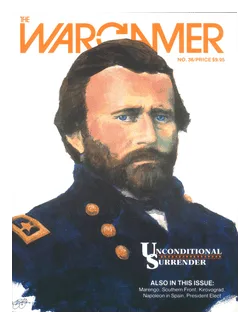
"Unconditional Surrender" was the wargame in issue #36 of The Wargamer Magazine dated December 1984. The game simulates the Confederate counterattack on Fort Donelson after the Fort had been invested by U.S.
Core mechanisms
Key systems that shape the decisions players make.
Grid Movement
Move pieces between adjacent spaces on a regular grid.
Dice Rolling
Roll dice to introduce uncertainty into actions, production, movement, or resolution.
Hexagon Grid
Use a hexagonal map where each space connects evenly in six directions.
Simulation
Model a real or imagined system through detailed cause-and-effect rules.
Read the full game description
"Unconditional Surrender" was the wargame in issue #36 of The Wargamer Magazine dated December 1984. The game simulates the Confederate counterattack on Fort Donelson after the Fort had been invested by U.S. Grant and the Union army in February 1862. The Confederate garrison actually outnumbered the Union troops 18,000 to 15,000, but Grant's judgement of his opponent's psychology served him well. The unconditional surrender of the fort on Febuary 16th, 1862, shattered the Confederate defenses in western and middle Tennessee.The equivalent of an entire corps was taken prisoner, and the Cumberland River was opened to the Union Navy. Within weeks Nashville would fall and the remaining Confederate forces would retreat into Mississippi. The victory made a national hero of it's previously unknown author, who here began his rise to command of all the Union armies - U.S. Grant. Yet the battle could have turned out much differently, and the controversy in later years over what really happened and why, would be among the most intense surrounding any action of the war.