Overview
At a glance
Is this game right for my group?
ABG editorial scores on a 1–5 scale.
Harder to teach
High replayability
Highly interactive
Scales well
Deep strategy
How it plays
How does it play?
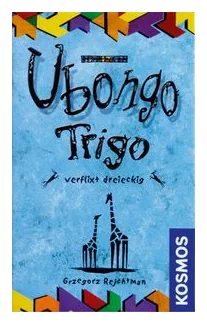
The Ubongo series has already challenged players with deciphering where to play shapes composed of squares (Ubongo itself), blocks (Ubongo 3D) and hexagons (Ubongo Extreme), so with Ubongo Trigo, the triangles now come into play.
Core mechanisms
Key systems that shape the decisions players make.
Read the full game description
The Ubongo series has already challenged players with deciphering where to play shapes composed of squares (Ubongo itself), blocks (Ubongo 3D) and hexagons (Ubongo Extreme), so with Ubongo Trigo, the triangles now come into play. Each player has seven shapes, each composed of a unique combination of triangles and each colored differently. In each round of the game, each player takes a puzzle board that uses four shapes (or six on the tough side) to create two images. Players are presented only with the images' silhouettes, so they need to determine how to combine which shapes – with which sides face up and in which direction - to create the two images on their card. The first player to do so starts counting down from 20 (30 for the tough side), and any other player who doesn't complete her board before that first player reaches zero gives her card to that other player as a point; any player who does complete the puzzles in time (including the first player) keeps his own board for a point. The player with the most points after eight rounds wins!