Overview
At a glance
Is this game right for my group?
ABG editorial scores on a 1–5 scale.
Harder to teach
High replayability
Highly interactive
Scales well
Deep strategy
How it plays
How does it play?
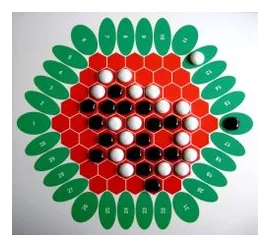
Tumbleweed is a two-player game. It is played on a hexhex board and a sufficient supply of stacked checkers.
Core mechanisms
Key systems that shape the decisions players make.
Area Majority
Compete to have the strongest presence in areas that award control or points.
Hexagon Grid
Use a hexagonal map where each space connects evenly in six directions.
Line of Sight
Visibility between pieces determines valid targets, movement, or effects.
Stacking and Balancing
Physically stack components while keeping the structure stable.
Read the full game description
Tumbleweed is a two-player game. It is played on a hexhex board and a sufficient supply of stacked checkers. A stack can "see" a hex, when they are connected by a straight line, with no stacks in between. The players take turns placing stacks of their tokens on hexes that are seen by at least one friendly stack. The height of every newly-placed stack equals the number of your stacks that see the new stack. Replacing an existing stack with a new stack is possible, as long as the new stack is taller than the previous one. This works with opponent stacks (to capture), or your own stacks (to reinforce). Before the game, the host sets up the board and the guest decides which side he wants to play. Setup consists of one stack of two neutral tokens in the central hex, and a single starting token for each player in hexes of the host's choosing. The game ends when no more moves can be made by either player, or after two successive passes. The player who occupies over half the board wins. Tumbleweed was voted Best Combinatorial 2-Player Game of 2020 on BGG.