Overview
At a glance
Is this game right for my group?
ABG editorial scores on a 1–5 scale.
Harder to teach
High replayability
Highly interactive
Scales well
Deep strategy
How it plays
How does it play?
Catchup is a simple abstract game with a devilish dynamic. The goal is to have the largest group of stones on the board when the board is full of stones, but as you get closer to winning, your opponent gets more powerful.
Core mechanisms
Key systems that shape the decisions players make.
Read the full game description
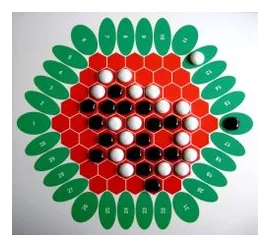
Catchup is a simple abstract game with a devilish dynamic. The goal is to have the largest group of stones on the board when the board is full of stones, but as you get closer to winning, your opponent gets more powerful. Whereas most stone-placement games are about position, Catchup is about timing, position, and the interplay between them. Definitions: 1. Group – a set of connected, like-colored stones on the board. A single stone is also considered a group. 2. Score - your score is the number of stones contained in your largest group. At the beginning of the game, both players' scores are set to 1 Rules: 1. One player owns the white stones and the other owns the black. White begins by placing 1 stone on any empty space. 2. From then on, starting with black, players take turns. On your turn, you may place 1 or 2 stones, or up to 3 if your opponent's score increased on their last turn and is, at the beginning of your turn, greater than or equal to your score. 3. After taking your turn, if your score has changed, move your pawn to the corresponding spot on the scoring track. 4. The game ends when the board is full. The player with the largest group wins. If the players’ largest groups are the same size, compare their second-largest groups, and so on, until you come to a pair which aren’t the same size. Whoever owns the larger of the two wins.