Overview
At a glance
Is this game right for my group?
ABG editorial scores on a 1–5 scale.
Harder to teach
High replayability
Highly interactive
Scales well
Deep strategy
How it plays
How does it play?
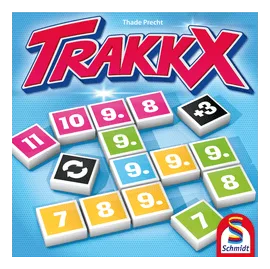
TrakkX plays like a combination of Rummikub and Qwirkle, with players trying to rid themselves of tiles by playing them in crossword-style arrangements. To start the game, each player takes fifteen tiles from the bag and arranges them so that no one else can see them.
Core mechanisms
Key systems that shape the decisions players make.
Read the full game description
TrakkX plays like a combination of Rummikub and Qwirkle, with players trying to rid themselves of tiles by playing them in crossword-style arrangements. To start the game, each player takes fifteen tiles from the bag and arranges them so that no one else can see them. Tiles are numbered 1-14 in four colors, with each number appearing twice; special tiles show a "swap" symbol and "+3". Six tiles are laid face up on the table, while the rest remain in the draw bag. On a turn, a player does one of the following four actions: Draws a face-up tile, then replaces it with a random tile from the bag. Draws a random tile from the bag. Uses a special action tile to force an opponent to draw three tiles or force each player to give two tiles to her left-hand neighbor. Plays one or more tiles. A player must first start a group in front of her by playing either a set of 3-4 tiles of the same number and different colors or a sequence of at least three tiles of the same color with numbers in ascending or descending order. Once a player has a group in front of her, she can play tiles on other groups already on the table as long as she doesn't create a set or sequence of only two tiles. A player can rearrange tiles and combine groups as long as no tiles remain on their own; if she combines groups, she can then start a new group. As soon as one player is out of tiles, the game ends and she wins. Alternatively, players can play multiple rounds, with those who still have tiles in hand scoring penalty points for what they still hold.